Saturday, September 1, 2018

LATE AGAIN...


…but this weekend I have no excuse, just a wonderful reason: our oldest grandchild is here from Texas with our youngest great-grandchild. Of course you know that blogging is not in the forefront of my mind. There will be ten for brunch tomorrow morning – ten, including 4½ month-old Everly. She is a charmer if there ever was one. Oooo -I could just take a bite out of her!

Our Texas bluebonnet are here!


This morning I am beginning to prepare the family favorite Sunday brunch dish, Baked French Toast Casserole. I’m doing a recipe and a half, because it goes like hotcakes. (I must say that I couldn’t get a boule this week, so I’m using two baguettes that I cut into nice chunks.)
This is an easy recipe to adapt and tailor for numbers or tastes.


Baked French Toast Casserole with Maple Syrup

                                                                  6 to 8 servings – or more!
Adapted from Paula Deen – and - 
   Adapted by Laura Lee Johnston  (a/k/a Grammy)    01/23/11              
Bottom of Form
Ingredients
  • 1 loaf French bread (13 to 16 ounces)   (I used one boule)
  • 8 large eggs
  • 2 cup milk
  • 1 cup half and half
  • 2 tablespoons granulated sugar
  • 1 teaspoon vanilla extract
  • 1/4 teaspoon ground cinnamon
  • 1/4 teaspoon ground nutmeg
  • Dash salt
  • Praline Topping, recipe follows
  • Maple syrup
Directions
Slice French bread into 20 slices, 1-inch each. (Use any extra bread for garlic toast or bread crumbs).  (LJ’s method – cut off ends of the boule, slice the rest into 1-1 ¼ “ slices. Should be 6 nice slices, then cut those in half – use the two ends for something else.  We buttered them and gobbled them up!) 
Arrange slices in a generously buttered 9 by 13-inch flat baking dish in 2 rows, overlapping the slices. (LJ’s method – arrange the 12 slices flat in the buttered or sprayed dish – or cut it all into 1” chunks.)
In a large bowl, combine the eggs, half-and-half, milk, sugar, vanilla, cinnamon, nutmeg and salt and beat with a rotary beater or whisk until blended but not too bubbly.
Pour mixture over the bread slices, making sure all are covered evenly with the milk-egg mixture. Spoon some of the mixture in between the slices. Cover and refrigerate overnight.
The next day, preheat oven to 350 degrees F. Take dish from the fridge and make the topping. Bake 1 hour until bubbly, puffed and lightly golden. Serve with maple syrup.

Praline Topping:   Combine all ingredients in a medium bowl and blend well.
  • 1 stick  butter, softened
  • 1 cup packed light brown sugar
  • 1 cup chopped pecans   (used 1 ½ lbs. because that’s the way the pieces were packaged – who doesn’t want more pecans!)
  • 1 Tbsp. flour
  • 2 tablespoons maple syrup(optional)
  • 1/2 teaspoon ground cinnamon
  • 1/2 teaspoon ground nutmeg


Saturday, August 25, 2018

NEW YORK SPECIAL


Every once in a while, Frank likes to watch the acerbic Judge Judy. While he's watching and I'm reading or writing on my PC, I'm always wearing my ear protectors - what I call my "ears." I do hear the blurred sound of the courtroom action, but it rarely grabs my attention. The Judge Judy theme, however, with its four notes - da da da dum - from Beethoven's Fifth, makes me look up to the TV screen. I am always delighted to see the intro film of New York City. I'm down here in South Carolina, and there is little chance I'll ever get to Manhattan again, but just seeing those program intros makes me smile.


I was born in Richmond Hill, Queens, a part of the great NYNY. I love New York – which to me is Manhattan. There was always, always a special little frisson of excitement each time I arrived on the island, even when I was in the city every day for a while during the opening of the now defunct First Women’s Bank, or every week doing research for a thesis. The best time of the year was Christmas in Manhattan. Looking back now, I think it was the recognition of the endless possibilities the city had to offer. For me, no other city has ever matched that feeling.


Saturday, August 18, 2018

A VERY BRIEF AND LIGHTHEARTED HISTORY OF GOLF AS WE KNOW IT TODAY

Holey Socks! It's Saturday again. More frequently these days, my blog posting has shifted from Friday to Saturday. When I began to blog, I posted several times a week. I suppose I had a lot to say, but at that time I wasn't writing for the our community magazine. Now I'm writing, editing, and coordinating. And in the last few months I've become involved on a new advisory council in the community. Their meetings are on Friday mornings, so all thoughts of blogging take a back seat.


This one is another article from the magazine. It was a fun one to research and write. I’ve never played the game, so what I know about golf is what I’ve picked up over the years. My brother was a big golf fan. In his younger years, he caddied regularly, and, of course, he played. An odd bit to keep in my mind, but I do remember that one of his favorite golfers was “Champagne” Tony Lema. Remember him? Every once in a while when our son is here on a weekend afternoon, we’ll watch a televised game. To me, it’s like watching grass grow, but does get a bit interesting when they get to the green and take shots at getting that little white ball into the "wee hole in the ground."

"Champagne" Tony Lema

“They” say – don’t “they” always – that the game of golf originated in Scotland, sometime in the mid-1400s. They also say it originated a century or so earlier than that in Holland, or in Belgium, somewhere in the Low Countries. Whoever invented it, and it certainly has proved to be a game in progress, the credit for the name “golf” goes to the Dutch and their word colf or kolf, and the credit for the modern, 18-hole version of the game goes to the inventive Scots.

Some historians paint us the picture of medieval Scottish sheepherders, watching the grass grow while the sheep kept shearing it, looking for something to pass the time. They probably knew little of the game already being played across the North Sea. As with many males looking to kill some time, they could have kicked a can, had they had one, skipped stones across a handy pond, played fetch with their dog, catch, if a buddy was around, or even taken a snooze. But then: “ah, a stick, a stone. How far I can hit the stone with the stick?” The rest as “they” say, is history.
 
Golf at St. Andrews in the 1700's
Whatever the origins, the game became popular in Scotland. Indeed, the Mecca of golfers worldwide is The Royal and Ancient Golf Club of St. Andrews there in Fife. With the exception of the United States and Mexico, “The R&A” is the ruling authority for the game worldwide.

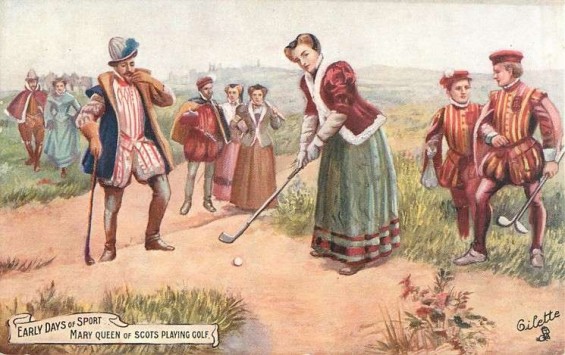
Golf became so popular that it had to be prohibited under certain circumstances. King James II had to prohibit golf and a few other popular games because they interfered with archery practice mandated a part of the national defense. Later, golf was also banned by King James IV, but he was known to play a round or two every so often. (The members of the SCCL Ladies 9-Hole and the Women’s 18-Hole clubs will be interested to know that though Mary Queen of Scots played it, golf was considered unsuitable pastime for a woman. Yea verily, Mary was chastised for playing the game.)

Did Mary lose her head over golf?

James VI of Scotland, Mary’s son, became James I of England in 1603. He brought golf south with him, and the Scottish and British brought golf to the countries where they were stationed. It must be mentioned that the first recorded game in America was the kolf played by Dutch settlers at Fort Orange, now Albany, New York, in 1650. We’re not sure which rules they used.


From ancient clubs fashioned by hand by the players themselves, and balls made of wood, a step up from sticks and stones, on to today’s wide range of equipment made of combinations of materials both modern and traditional, and some very experimental, the sport has kept up with technology. In the United States alone, there are over 15,000 places to play a round. Today’s golfer can set himself or herself up with a range of equipment and clothing designed to make the most of individual’s ability to get that little white ball, hazards notwithstanding, into that far, wee hole in the ground.

Saturday, August 11, 2018

COULROPHOBIA - MORE CLOWNS


One recent morning, one of my regular email subscriptions brought me this:
English Word of the Day from Oxford Dictionaries
Your word for today is:  coulrophobia - extreme or irrational fear of clowns
I don’t fear clowns, but I certainly don’t like them. When I saw the word entry, it reminded me that I’d posted about clowns before. I’ll have a comment or two after, but meanwhile - in August of 2013, I posted:


Did you see this article from Smithsonian on The History and Psychology of Clowns Being Scary?  That first picture could send you screaming off into the night. Smithsonian didn’t have to tell me that clowns are scary – I’ve been a non-fan, shall we say, all of my life.  I kinda liked Emmett Kelley’s Weary Willy when I saw him at the circus when I was a little kid.  Was he the clown that swept the spotlight into the corner of the ring and then ‘under the rug’? (Yes, he was, I looked it up!) But it’s all a blur.


And I never did like Clarabelle or Bozo.  My sister got to go on the Howdy Doody Show – she won a pair of ice skates – but I didn’t care for that show. I got to go on Buster’s Buddies – no clowns – and I won a Toni Doll. Remember those?  Anyway, I knew there had to be an innate reason for my not liking those big red-mouthed clowns. I’ll be darned if I can find a current on-line reference to it, but years ago I read that the wide red mouth evolved from the Renaissance practice of slitting the clown’s mouth to make a wide grin. Gruesome!

I do remember thinking the bit where clowns got stuffed in the tiny car was really stupid. Who knows why – it just struck a sour note in me. But the rest of the circus – I loved it! I loved the elephants and the big cats, the high wire acts and the acrobats, and remember the man who balanced on just one finger? Neat stuff.  I haven’t been to the circus in eons – the memories will suffice.
Clowns themselves evolved from the motley-dressed court jesters of the Middle Ages who could answer back to anyone, even the king, and were given a wide range of freedoms enjoyed by no others, and were often the impetus for change. I am a fan of Alan Gordon who has written a wonderful series of mysteries around a jester and The Fools Guild – Thirteenth Night is the first in the series.  Never mind sending in the clowns, send in the jesters – they’re no fools, and this world could use quite a few of them.


Back to today – August 2018. I had to laugh at the last sentence of that post – “send in the jesters.” Well, two years ago the great American electorate sent in no jester: they sent in a clown. Funny thing though, he doesn’t make me laugh. He makes me cringe. He gives me a case of coulrophobia.

Ha! I went to find a picture of our president as a clown - there was quite a selection. And there I found this:


A circus is just what we've got.

Saturday, August 4, 2018

MISTY MORNING


Picture from a misty morning at my house


I arise in the morning torn between a desire to improve the world
        and a desire to enjoy the world.
       This makes it hard to plan the day.
                                                                              E. B. White

Friday, July 27, 2018

WHAT'S IN A NUMBER?


"Please tell me if you can what time do the trains roll in?
    Two-ten, six-eighteen, ten-forty- four.”
           Lyrics by Rod McKuen

I do like numbers. Even the time of day makes me smile if the numbers are familiar, like the ones in those old folk song lyrics above, or my birth month and day, or are in a good set like 7:11 or 12:34. We are surrounded by numbers: phone numbers, pin numbers, numbers games, TV channels, Interstate and highway numbers, merchandise prices and sales discounts, addresses, days and dates, times, and temperatures, 24/7/365, ad infinitum.

We know that mankind must have used numbers, at least in his head and in his speech, from the time he began to think and realize what was out there, what he had, and what he wanted. What was the first numerical thought? It may have been “I see one lion,” or “I have two days’ worth of food.” He had to think in more precise terms than one or many. He realized he had fingers and toes on which to count. Fingers and toes, our first numerical system, are referred to as digits, from their Latin name, digitus. Man started recording numbers as notches on a bone. When man was able to find a bit of leisure to think beyond daily survival, civilization developed. Along with it came ancient formalized numerical systems.


There are many such systems, including those of the Egyptians and Babylonians, the Greeks, the Hebrews, the Chinese and Japanese, and others. The system still used for numbering special events, like Super Bowls and Olympic Games, is the Roman system of combining I’s, V’s, X’s, L’s, C’s, D’s, and M’s to designate numbers. How many times have you tried to do a quick translation of the date run at the end of an old movie? One beauty of a date is MDCCCLXXXVIII. Its 13 digits translate to 1888. Add another millennium, add another M. The system supports only basic addition and subtraction: add a letter here, take one away there. Don’t even try to multiply or divide them – the Romans used an abacus for that, as did the Chinese and Russians. Abaci are still in use in many parts of the world.

Several numerical systems had the concept of zero, but in most it was just a vacant position. In some it was depicted as a disc with an empty or vacant center. (Is that familiar?) The Roman system, and many of the other in the world, had no place for zero. The zero and numbers we use today are the legacy to most of the modern world from the Hindu-Arabic system that preserved and further developed the science and mathematics of previous cultures. The Moors brought their knowledge to North Africa and on into Europe, thus we call the numbers Arabic. Mathematicians and scientists soon realized the beauty and utility of the simple numbers. Bankers could calculate interest out to several decimal points, merchants could price their wares effectively, and mathematicians could begin to use the fractions, quadratic equations, and algebra already in use in the Middle East. The next step in numerical system development wouldn’t come until 1679, and the development of the binary system of representing numbers. That development, on hold for a while, eventually led to our modern digital age – there are those digits again.

Fibonacci Numbers


From Pythagoras and Euclid to the modern practitioners, mathematicians have come up with all manner of special numbers like primes, pseudoprimes, and palindromic primes, composite numbers, square roots, perfect numbers, Fibonacci numbers, Cullen numbers, Avogadro’s number, ad infinitum. Speaking of ad infinitum, don’t ever forget the exact number for Ï€ – that’s pi. And if you live numbers, as did the late Stephen Hawking, numbers can take you to the universe.

I’m not too mathematically inclined. Over the years, as have most of us, I’ve picked up a bit of trivial numeric knowledge. I do wish that my first Algebra teacher had given us a nutshell history of the whys and wherefores of mathematics beyond simple arithmetic. It might have made the subject more interesting, memorable, and retainable. I had to take Advanced Algebra and Trigonometry in high school, and I do know I passed the courses, but I don’t remember any of the course work. I do best with basic arithmetic and eighth-grade fractions. I’m set for life, math wise: that knowledge of fractions comes in very handy in cooking, and my checkbook always balances.


Friday, July 20, 2018

GHOTI


You know ghoti, don’t you? It’s pronounced ‘fish’ – yes, that’s right:
   Gh as the gh in cough – that would be your f
   O and the o in women – that would be your I or ih
   Ti as the ti in fascination – there’s the sh

Fascination – yes, it’s fascinating to me how words are spelled and pronounced so differently, sometimes so illogically.

In England, Worcestershire is pronounced as Woos-ter-shire or sheer.
Here we pronounce Westchester as Westchester, why don’t we pronounce it as Wester – leaving out the chest. Well, I fully realize that there are precedents for this, but I love to mess with words. The British must always have been in a hurry. They seem to have shortened whatever words they could. Featherstonehaugh is pronounces Fee-ston-hue, Cholmondeley is pronounced Chumley – one syllable less. Dalziel is pronounced Dee-ell. Were they always in a hurry to pronounce the names and get them over and done with?

While I’m rambling on about words, my favorite questionable words are names from China. I know that a according to my favorite Wikipedia:
“Pinyin, or HànyÇ” PÄ«nyÄ«n, is the official romanization system for Standard Chinese in mainland China, Malaysia, Singapore, and Taiwan.” 

But when they were “romanizing” the words, why didn’t they pay attention to the spelling vs the pronunciations. Most readers and speakers of the Roman-based languages would, at first glance, know how to pronounce my favorite Feng Shui. They’d pronounce it as it looks: feng schwee or shooey. But no, it is pronounced fung shway.  So why didn’t they spell it that way? Am I making sense to you? 

Many of the romanizations, like changing Peking to Beijing, still baffle me.
The Chinese government changed it to Beijing when they adopted the Pinyin. Most westerners pronounce it Bay-zhing. It is supposed to be Bay-jing. Hard on that j. O.k. – I get the jing part, but why did they use Bei, not Bay? I’ll never know, and it’s good fodder for a grump session.

And then there was Noah Webster. The teacher in him that was dissatisfied: generally with the state of education in the new Untied States, and specifically with instruction in the English language. He set out to standardize spelling, and for the most part he did a fine job. He changed gaol to jail. He did eliminate the u’s in words like colour and favour, ones we’d now pronounce here as coloor and favoor. We know that works like philosophy and psychology are not filosofy and scicology – it’s because of the Greek or Latin word roots. But why do we have rough, cough, and hiccough? 

“‘Tis a puzzlement!”

Friday, July 13, 2018

THE MARCH KING

What better month to celebrate The March King than July - what would our Independence be without a rousing march or two? This article was posted in this month's issue of our community magazine


“Da, da dee dah-dah, de dah, de dah, de dah.” Of course you recognize the opening bars of “Stars and Stripes Forever.” Don’t you? (There’s no way to put those opening bars, plus the cymbals crash, into print. You’ll have to hum to yourself.)

There’s nothing like a stirring march to get our patriotic juices flowing, and there’s nothing like a Sousa march to top them all. John Philip Sousa* was born in 1854 in Washington, D.C. He began with the violin, at age six, and went on to master the piano, the flute, and several brass instruments. He was a natural. His father, a trombonist in the U.S. Marine Band, enlisted his son, age 13, in the corps as an apprentice so that he wouldn’t run off and join the circus – the circus band, of course.

After his first stint with the corps ended in 1875, he learned to conduct while he was in a theatre orchestra. Thus, when he rejoined the corps, at the age of 26, it was the leader of the band. He led the Marne Corps Band for twelve more years, after which he left to form his own band. In the years that followed, the Sousa Band performed all over the world. Interestingly though, over all the years, they marched only eight times.

You can sense the concert audiences sitting and tapping their toes to the Sousa marches, but there was other music offered as well. Sousa, The March King, also wrote many popular operettas, dozens of songs, and other pieces such as overtures and suites. Among his 136 marches, though we may not remember their names, the tunes of “Stars and Stripes Forever,” “The Washington Post,” “Semper Fidelis,” and “The Thunderer” are familiar to us all.
                                                   
No sousaphones in the Marine Band

In almost every marching band across the country, there is at least one person beholden to Sousa for inventing the sousaphone. A typical concert tuba weighs in at 25 to 35 pounds, and though a sousaphone can weigh just about the same, the tuba’s circumference is several feet. It’s fine for a player to let his chair hold it for him while he plays in the orchestra, but it is a beast to heft if he has to march with it.

Sousa recognized the problem. In 1893, providing ideas about what he needed, he asked Philadelphia instrument maker, J. W. Pepper and Sons, to design a tuba that could be carried. The sousaphone was based on the helicon, a much older but awkward instrument that could also be carried. The sousaphone incorporates different features that make it comfortable for the player to carry, as well as to play.

Though there were once jumbo sousaphones that weighed 60 pounds, the average one weighs 30 to 35 pounds, give or take the weight of the music holder.  And, would you believe it, there are Sousaphones made of fiberglass that weigh only about 15 pounds. No brass there.

Ready to march in the festivities in Saint-Rémy-de-Provence, years ago,
this sousaphone-wearing gentleman was the clown of the event.
His eyes were very expressive. 


As Elizabeth Eshelman, a onetime sousaphone player, wrote, “There’s something about a wearable tuba that brings out the—goofy? show-off? animalistic? flamboyant? side of the tubist, and when you consider that one must already have a screw loose to choose to play the tuba, you start to realize that the sousaphone is really its own beast.”  Next time you’re at a football game or a big parade, make note of the antics of the sousaphone players – they’re a fun bunch.


* Don’t believe the wags who’ll try to tell you his surname was So, and that in a patriotic gesture he added the USA to his name. ‘Tain’t so!


Friday, July 6, 2018

DEFINING "FRIEND"

I've saved this picture for years because it shows an Amosandra doll,
one I had and loved way back in the late 40's


Though there are many multi-word, multi-sentence, descriptions for someone you know, for a great language like English, there is sometimes something missing. In Japanese, whole concepts can be embodied in just one word. Like all the Inuit words for snow and ice, we need a series of single words to describe the people in our lives, especially those we know only from brief encounters.

Do you remember Joan Walsh Anglund’s book A Friend is Someone Who Likes You? If that is true – that a friend is someone who likes you - then many people have many friends. We like most people we meet. We’d like to have a lot of friends, but are they really friends? If you like the gal who regularly checks out your purchases at the supermarket, is she your friend? Not likely. An acquaintance? Well, maybe. We’re acquainted with many people in the community, but it’s quite a long way from acquaintance to friend. If asked “Do you know Susie-Q,” an acquaintance from club meetings, you might not be able to answer “Yes, she’s a friend of mine,” because it could lead to more questions than you have the knowledge to answer. In that instance, you might just have to say – “Yes, I know who she is.”

I believe we can know who our own friends are by having the relationship pass a test or two – do you trust them, do you love them, would you discuss your health with them, would you discuss your marriage with them?

Further questions wouldn’t arise if we had more precise labels for the way we know folks. Well, most of us seniors like to gab anyway, so it might not be necessary to be brief. Besides which, it might lead to a good, perhaps juicy, conversation about the person in question.


Friday, June 29, 2018

A QUICK, COOL, SUMMER PIZZA


It’s been too hot here these past few weeks. If I can easily do so in the summer, I bake in my toaster oven for less heat in the kitchen. If I can easily do so at any time, I take shortcuts. Last night’s shortcut was to forget my regular pizza dough and make pizzas on baguette slices. Assembled, under the toaster oven broiler until they browned nicely, and served, they were just right for two.

Almost everyone enjoys pizza. We former New Yorkers lament the near inability to reproduce it here below the Mason-Dixon Line. We lament that the difference is in the sauce, or it’s the crust, or it’s the cheese and toppings. No matter the shortcomings of the local pizza, we still manage to keep all the local Italian restaurants and pizza purveyors in business.

I do favor a thin, crisp crust – one where you can fold the slice lengthwise and just the very tip may droop. My own biggest pet peeve is the sauce. Somehow, most of the locals miss on that unique combination of tomatoes, garlic, and spices.

I usually make my own pizza: sauce and crust. Recently, I’ve worked up the perfect sauce for two. It’s a derivative of one I saw on TV’s “America’s Test Kitchen,” and it suits my New York, New York-born taste buds.

Quick Sauce  for Two

1 14 oz. can diced tomatoes, very well drained
½ Tbsp. olive oil
½ Tbsp. vinegar
1 tsp. minced garlic (or more totaste)
½ tsp. dried oregano
¼ tsp. salt

Process the drained tomatoes with a hand blender or in a processor until they are still a bit chunky. Use the sauce on top of pizza for two.


Friday, June 22, 2018

WE NEED A SACKFUL OF SOLOMONS


I had an “oldie but goodie” blog to trot out for today’s post, but I’ve relabeled it for anytime in the future because this morning two news items caught my attention.

“What right have feminists to march in and say we don’t want this anymore?”  This was the BBC’s Anne Robinson on the topic of “grid girls.”
These are the gorgeous, usually well-endowed young gals who get to spend a few hours at a motorcycle or sport car race, mingle with the teams and drivers, get suitably outfitted for free, and all for a nice fee of around £180 in England, $230 or so on this side of the pond, and an unknown amount of Euros, Yen, or Dirhams (Well, the Dirhams are moot because there’ll be no more rid girls at the Abu Dhabi and Bahrain Formula 1 races, and they’re on their way out elsewhere on the circuits.)

The gals love what they’re doing, and don't at all feel they're being exploited. Being weekend or occasional grid girls is not their main occupation. All are otherwise “suitable employed.” It is said that they “are clearly at odds with societal norms.” I say “let them be the judge of that.”

Political correctness is one thing, common sense is another. We need a sackful of Solomons.

Speaking of common sense, where were Melania Trump’s minders yesterday when she trotted out that jacket bearing the phrase “I really don’t care, do u?” First of all, her destination was a place that is sensitive to everyone these days. She really should care, and maybe she does – or is she just going through the motions. When questioned, various “sources” had various reasons why she wore the jacket. Some say she wore it to show that her wardrobe does have a few inexpensive items in it. Some say she was commenting on a completely different topic.
Most of us don’t care for the why of it – maybe she just pulled a random jacket out of her vast closet - but we do care that her actions reflect poorly on her and, perhaps, on the rest of us. There’s no “#me too” about this incident.

That’s it for this Friday – the Curmudgeon has spoken.


Friday, June 15, 2018

WHAT AM I?

I always like this picture of me. I was my "official" portrait taken
when I was made an officer at the bank where I worked.
Looking at some of the pictures I have of me, I decided to trot this one out for this post.

Recently, I subscribed to emails from Prime Woman, a website that is “redefining the ageless generation.” I’ve read some interesting articles there. One recent week they ran the article “Finding Purpose After Retirement: Who Do You Think You Are?” Topics like this are new and somewhat strange to me.
First: finding purpose after retirement. I was very fortunate to be able to retire over thirty-five years ago. (I’m 75, do the math.) Never once in all those years did I ask myself about my purpose. Then they asked “Who do you think you are?” I’ve never thought about that one either. Maybe it was time I did.

The article suggested that you take a piece of paper and in five minutes write down the words or phrases that complete the sentence “I am_______.” Geeze Loueeeze, what am I? Who am I?

What I wrote:  I am…
…lazy, therefore sometimes anal about keeping things tidy
…an introvert, though many wouldn’t think it
…a giver of things, not time
…happy
…inventive
…very self-centered
…fairly smart

Later I looked again at Prime Woman’s various lists, and thought about mine. I recognized that I never included the word “stressed” though at this point I am. I suppose that what others would call stress, I take in stride. And, unlike some other women, I never included what I did. I am, among other things, a blogger, a community magazine writer and editor, a retired banker, and a housekeeper. (Housekeeper: the name of a Girl Scout badge I earned in fifth grade.) I am Laura Lee Johnston – I am me.


Saturday, June 9, 2018

THINGS I HATE


The Pleasures of Hating

I hate Mozart. Hate him with that healthy
pleasure one feels when exasperation has

crescendoed, when lungs, heart, throat,
and voice explode at once: I hate that! —

there’s bliss in this, rapture. My shrink
tried to disabuse me, convinced I use Amadeus

as a prop: Think further; your father perhaps?
I won’t go back, think of the shrink

with a powdered wig, pinched lips, mole:
a transference, he’d say, a relapse: so be it.

I hate broccoli, chain saws, patchouli, bra-
clasps that draw dents in your back, roadblocks,

men in black kneesocks, sandals and shorts —
I love hating that. Loathe stickers on tomatoes,

jerky, deconstruction, nazis, doilies. I delight
in detesting. And love loving so much after that.

_ooOoo_


Well I’m with the poet on a lot of the things she loves to hate. In opening that morning’s now defunct The Writer’s Almanac, the word “Mozart” caught my eye. I can’t say I hate Mozart, but most of what I call his “twiddley music” annoys me and could give me the jitters. It isn’t melodic, lyrical or smooth. I can’t hum it to myself as I can “Finlandia.” 

But I digress…

…things I hate:
·         Yes – those tickers on tomatoes, and peaches, and apples, and pears too
·         Yes also to deconstruction. Who cares what the author or composer meant? Shut up and enjoy the work.
·         Doilies? Does anyone use doilies these days?
·         People who don’t read to the end of anything - email, article, book, announcement – and then go off halfcocked, ranting and raving about something they’d have known if they’d have read the whole thing – ah, well!
·         And also – old people who think they can do or say anything they want, just because they’re old
·         Vegetables like kale and broccolini that have become diet darlings – and isn’t there a new diet darling each week?
·         Wearing anything that looks like it was made out of an American flag
·         Celebrity singers at sports events who murder our national anthem - our anthem should be sung belted out by the whole crowd.
·         Cable TV stations that repeat the same old programs ad nauseum – I’m not sure how they justify their existence to the FCC, but I’m sure they stay in business to rake in the advertising dollars.

My list might go on forever – ad nauseum – but that’s enough for now. If you are so inclined, you can click on “Curmudgeon” on my list of Topic of Interest, over there on the right.

The poet and I think the same way: I love loving so much after that.


Saturday, June 2, 2018

A BUCKET LIST FOR MY NEXT LIFE


O.K. – I’m 75 and not in the best shape. There are so many more things to do on this earth than there were when I was fit and forty or fifty years younger. One recent day, it struck me that I am particularly jealous of kayakers. I never envied the Inuit their kayaks, but I would very much love to have a new kayak large enough to stow my gear for a meander down an interesting river. Moreover, I would very much love to be able to get into and out of a kayak – my legs and knees are no longer very cooperative. I have canoed in my lifetime, when I was younger and much more spry, and I enjoyed it tremendously, but the enclosure of a kayak somehow has more appeal for me.

So – on that day when I that jealousy struck me, I decided that I would start a bucket list for my next life. Kayaking would be at the top of the list. Truth be known, remembering this life would be at the top of the list, but we can’t have everything.

My list – a work in progress:

Get a kayak and meander on a river

Take a ride, 10 feet up, on an elephant

Go whale watching

Learn to SCUBA dive

See Petra, the Taj Mahal, Abu Simbel, and Uluru-Ayres Rock, Machu Picchu


            …I’m still thinking.

Friday, May 25, 2018

A CHIP OFF THE OLD BLOCK...

                                                                       ...of chocolate.

Another one of the articles that was fun to research. This week, I made a big batch of chocolate chip cookies for Frank. I packed a bit of extra nutrition in them by substituting a cup of quick-cook oatmeal for a cup of the flour, and adding chopped pecans. Here in the South you must add pecans wherever you can. I freeze the dough balls and bake the cookies a dozen at a time. If I baked 'em all at once, I'd eat 'em all at once.

These are what we use toady as chips for our cookies
(I prefer the Hershey Special Dark myself.)

They’re out there, but very hard to find: those without a sweet tooth, those who never, ever savored a chocolate chip cookie. Breathes there a man with soul so dead, who never to himself has said “this chocolate chip cookie is as American as baseball and apple pie.”

It is American. The exact date on which the first chocolate chip cookie was baked is not precisely known, but it was somewhere early in 1938, some 80 years ago, that the idea of them came to Ruth Graves Wakefield. At the time, she owned the Toll House Inn in Whitman, Massachusetts – thus their original name: Toll House Cookies. The chefs at the inn were very creative, so much so that they produced the classic cookbook Toll House Tried and True Recipes. The 1977 edition is still available. People were eager to follow the recipes of this very fine establishment. Evidently, the Massachusetts boys serving during World War II got the cookies in care packages from home, and shared them with their buddies. The joy of them spread like cookie dough in a hot oven.

The first chips were just that: chips off the chocolate on hand for the chefs at the inn, and technically, if it’s called a Toll House cookie, it is pristine: just the basic original recipe cookie dough with chips of chocolate.

These are more like the chips of chocolate used at the Toll House Inn

They say that if you change at least three ingredients in a recipe you can consider it yours. There have been so many changes to the original Toll House Cookies recipe that today’s recipes are anybody’s. Even the recipe on a Nestlé’s “morsels” departs from the original, substituting butter or margarine for the original shortening. The recipes today are as many and varied as those for spaghetti sauce or the many other foods that have become fixtures on American tables.

Chips are no longer chips: they’re extruded drops. And they are no longer just chocolate: they can also be semi-sweet, bitter-sweet, white chocolate, butterscotch, peanut butter, cinnamon, even mint. And chips can be regular size, chunks, or minis. To the dough you can beat in oatmeal, cocoa, walnut, pecans, hazelnuts, macadamias, raisins, dried cranberries, toffee, tiny marshmallows, and what? The beat goes on. Are they still chocolate chip cookies?  Probably yes, if there is still some chocolate in them.


The original drop cookie of about 2½ to 3 inches in diameter has grown. Some big, fat five-inchers are pikers. Chocolate chip cookies can be found in pita, plate, and pizza-size portions. We Americans like to make everything bigger, but Cookie Monster might consider some of those larger versions to be monstrosities, both size-wise and taste-wise.

National Chocolate Chip Day is celebrate every year on May 15. National Cookie Day is December 4 (time to start baking for the holidays) and, put them together and you get National Chocolate Chip Cookie Day on August 4. You might want to find other reasons (your Mother-in-law’s birthday, your neighbor’s new car) to celebrate with chocolate chip cookies. It is the American thing to do.