Showing posts with label Books. Show all posts

Saturday, November 11, 2017

NEITHER HARD BOILED NOR COZY

Here's another article I wrote for our community magazine's current issue. I've read many complete mystery series, and none have pleased me more than those of Donna Leon and Louise Penny. I recommend them highly.

Ah, oui! Poirot en Paris


Many mystery and suspense writers invest quite a bit of time and pages in fleshing out their characters. Once established in the minds of their regular readers, they can dispense with a lot of background details. From the beginnings of these types of fiction, many of the main characters have become household names: Sherlock Holmes, Hercule Poirot, Brother Cadfael, Jason Bourne, George Smiley, Kinsey Millhone, and, of course, James Bond – the list goes on. Readers become great fans of these characters, and most of them have found their way into the big-screen and TV movies.

Two newer characters that can be added to this list, movies included, are Guido Brunetti and Armand Gamache. There are now twenty-six Brunetti novels since the series began in 1992, and thirteen Gamache novels since 2005.

I had Brunetti in my head long before the series started,
and he doesn't look like this - and never as scruffy.

Donn Leon’s Commissario Guido Brunetti plies his trade in Venice, “La Serenissima.” From the first novel, Death at La Fenice, the opera house, to the most recent, Earthly Remains, published in April 2017, readers know that Brunetti will investigate a murder or two and, usually, some connected nefarious doings in and around the city. He’ll have the help of some on-going, memorable colleagues and characters at the Questura, the police headquarters, and he’ll invariably head home for lunch. Your mouth will water as you read what wonderful things the family is having for lunch. The dishes are so memorable that Leon gathered the recipes into A Taste of Venice: At Table with Brunetti, otherwise known as “Brunetti’s Cookbook.”

The solving of the crimes and the discovery of the several interconnected mysterious situations make for intriguing reading. While reading the books, and they can be read in almost any order, you might want to send for the handy, plastic-coated “Streetwise Venice” map from Amazon, to help you follow Brunetti around the city on foot and by water. Next time you visit there, you can book a tour of “Brunetti’s Venice.”

This is close to the Gamache in my head.

Louise Penny’s Chief Inspector Armand Gamache is headquartered at la Sûreté du Québec. While Brunetti’s only problem at headquarters is an inept, social-climbing superior, Gamache, while looking into his many cases, is also combating a few back-stabbing, scheming colleagues. His personal and professional problems are a backdrop to the case at hand. Though he travels a bit through Quebec and Montreal, most of his cases take place in and around Three Pines, a very small, mythical hamlet in Quebec’s Eastern Townships. After reading just the first novel in the series, and it is best to read them in order, most readers want to pack up and move to Three Pines. In 2015, St. Martin’s Press, Louise Penny’s publisher, printed a map of Three Pines, and several lucky readers were able to acquire one. Though, like me, they found it to be almost like the map in their heads, it was a case of “almost but not quite.” Like the personalities and quirks of the dozen or so recurring characters, the personality and quirks of Three Pines etch themselves into memory. The first book in the series is Still Life, the most recent, out this past August, is Glass Houses.


Louise Penny's publisher, St. Martin's Press, published a map of Three Pines.
I was lucky enough to receive one. 

You can always tell how widely anticipated are the novels of these two award-winning writers, by the great discounts that mount up at Amazon in preorders in advance of their next publications. The discount usually gets up to at least a third off the publisher’s cover price. Be warned though, you might be up all night: they are not “hard boiled”, neither are they your “cozy” mysteries, but the books are really “page-turners.” 


You may want to read my blog on "The Maps in Our Heads" here, 
or "Mapping an Authoris Landscape" here.


Wednesday, September 6, 2017

STILL - I BUY BOOKS

My cousin reminded me that today is National Book Day. (Thanks E!) I thought it appropriate to re-post this one from March 2013. Buy or borrow, books are my delight. All these years later, I've even have given in to the Kindle way of reading, though I still prefer a book in my hands.


I don’t smoke or drink or even chew gum. My vice: I buy books. Many are worthy of any good library, many, some of you might think, are not.  Recent purchases in the former category include Jacques Barzun’s From Dawn to Decadence: 1500 to the Present, and the Merriam Webster New Book of Word Histories. The latter? Well, let’s just call them Fiction: Romances, Mysteries, Romance Mysteries – I’ve a long list of favorite authors.
Since 1990 when I stopped lumping in book money with the rest of our entertainment expenditures, I’ve spent just over $14,000.00 on books, many of them used. Egad! That’s a nice chunk of change.  I’m sure the lifetime total would be nicely impressive too, and I delight in every dollar’s worth.
I was reading Theodore Dalrymple’s essay Why second-hand bookshops are just my type, and I came upon the telling of a bibliomaniac whose library was sold after his death for only a third of what he’d paid for the massive collection. I sold off my college text books – about twenty years later - but I can’t imagine selling my books now. I’ve always given them away when I was finished with them. I’ve read many of my books four or five times, but usually when I’ve read a book twice – or have gotten only part way into a real dud – it goes into the bag to be taken to the library for the sale room.  Sell them? I’ve not got the time: I’m reading!
Dalrymple’s essay mourns the passing of second-hand bookshops. I’ve rarely had the pleasure of browsing in a second-hand bookshop.* I do now have the pleasure of browsing in second-hand book sites on line. My favorite is Thrift Books, and Britain’s Awesome Books is pretty well that: awesome.
Really, really esoteric volumes can sometimes be found, used, of course, at Amazon – but then, what can’t you find at Amazon?  I do browse the shelves of the sale room at the library – always going with book lists in hand to be sure I’ve not read that one before, always looking for new treasures. (And library sale rooms are great sources for children’s books. I’ve got on hand new birthday and Christmas books for my granddaughters well into 2016, but used books are great to hand out throughout the year for un-birthdays and such.) 
I don’t know if you’ll think this good or bad, but though I’ve always belonged to the library wherever we lived and occasionally do check out books, I’d really rather own a book than borrow it. If it is mine I can take as long as I want to read it: though I read many books in a week, it gives me the itch to have a time limit on my reading.  If it is mine I am happy to let it just sit in my stack of to-be-read and enjoy its being there.

In one paragraph, talking about the pleasures of finding markings and various papers and bookmarks in used books, Dalrymple says “there is no substitute for being able to hold the physical book in one’s hand.” I agree wholeheartedly – but for another reason on another plane: I don’t think I’ll ever be comfortable with an electronic book. A good friend of mine has shown me the wonders of her iPad, and how she can enlarge the type, and how it remembers where she left off, and all the other delights of electronic reading. Not for me. I want to be able to flip back to that remembered reference to a certain character or place – and I remember it was on the left hand page about two inches from the bottom. Yes, there it is. I remembered the ‘landmarks’. Can’t do that with an electronic book. 
This is just a fraction of the books I once owned. I keep them
and all my little dustables in our bedroom - this way none of it
has to be dusted very often.
I want to hold the book and not have to be too careful not to drop it in the toilet if I’m in a bathroom reading session – though there I usually read magazines. I want to refer every once in a while to the jacket’s cover picture or inside blurb and bio. I want to see my books – especially the ones I’ve kept and reread for years. Just seeing the books on the shelf gives me a fleeting remembrance of the story. I can’t get that feeling with an electronic device.

Books are neat and compact, easier to collect and store and dust (though I rarely do) than say salt and pepper shakers or automobilia. Yes, for many reasons on many levels, I’ll stick to books as my vice of choice.

*but I love pictures of them – so higgledy-piggledy, stacks and stacks.  As the bibliophile’s lament goes: So many books, so little time. 


Friday, January 27, 2017

FIFTY FRIENDS

Well, maybe not this many 

Last year in January I read this in The Writer’s Almanac on the 16th:    

It’s the birthday of novelist, essayist, and cultural critic Susan Sontag (books by this author), born Susan Rosenblatt in New York City (1933). She grew up in Tucson and Los Angeles. She was a voracious reader from the age of three, and the first book she remembered being thrilled by was Madame Curie, which she read when she was six. She remembered lying in bed as a child and gazing at her bookcase: “It was like looking at my 50 friends. A book was like stepping through a mirror. I could go somewhere else. Each one was a door to a whole kingdom.”


Fifty friends – oh, more than fifty!  Books have been a necessity for me, like love and food, since I was aware of them and able to hold them. I’ve had many books given to me, and I’ve spent a tidy sum on books ever since I had the means to do so. It follows that I’ve also given away many, many of them. I’ve had only so much room in the homes where I’ve lived over the years. There are also a few real treasures that have “grown legs” over the years, and I do miss them terribly. But my very old-time friends are still on my shelves. Just a passing glance at one of their spines brings the whole story back to me in an instant. The flavor of the book runs a quick video through my memory. I can’t say the same happens when I see some of the newer books on my shelves. Old Friends are the best friends.

Saturday, April 16, 2016

ANATOLE FRANCE AND BOOKS


Today is the birthday of Anatole France, born Jacques Anatole Thibault, in Paris, France of course, in 1844. And how do I know this? I read, of course. According to The Writer’s Almanac, one of my favorite sources for blog ideas, France said, “The books that everyone admires are the books nobody reads.”

I have to admit, and really not ashamedly so, that though relatively I’m widely read, I’ve never read many of the classics that one would think I should have. In many random works of fiction I’ve read over the years, I’ve come upon characters who were extremely well versed in the classics – that’s perhaps because their creator was. For the longest time I wished I were similarly well read, but then I gave up on that. I’ve never read more than excerpts from works like The Iliad, The Odyssey, nor any of Jane Austin, and only the Dickens works I read I was required to read in school. I know most of his stories, but I really don’t like Dickens style of writing, nor do I like Edith Wharton’s. I do like John Steinbeck’s style, so I’ve read all of his works, including the delightful Travels with Charlie.

I have read, Gargantua and Pantagruel, War and Peace, Crime and Punishment, but not Pride and Prejudice. Sorry. I’ve read Don Quixote, and Animal Farm, and The Wind in the Willows, but not all the Harry Potter books because I like Susan Cooper's The Dark is Rising Sequence of books so much more.

List Challenges has an entry: 99 Classics Books Challenge – of which I’ve read 45 according to their count, I think. Sometimes I don’t remember if I’ve read it or not because I know of it in one way or another. Maybe I saw the movie! There were only two on the list that I’d no knowledge of at all: Baltasar and Blimunda, and Os Maias. (I’ll have to research them.*) So – 45. I’ve read a hell of a lot more than those 45. Good for me? One never knows. At the end of the day, at the end of my life, will it have made a difference?  One never knows.


*I learned that these two are by Portuguese authors. In reading about the novels, I’ve decided they won’t be on my list of things to read in the future. Que pena. 


Friday, August 14, 2015

A BOOK IN THE HAND IS WORTH TWO IN THE TABLET

SCROLLS IN THE LIBRARY AT ALEXANDRIA

A thought-provoking meme came my way this week: Ten Things that Will Disappear. It goes on to say that they’ll disappear “in our lifetimes”, but I think this one was originated by someone very, very young. It predicts the demise of, among other things, the post office, the check, the newspaper, and the land-line telephone. Well, that one went out years ago at our house.

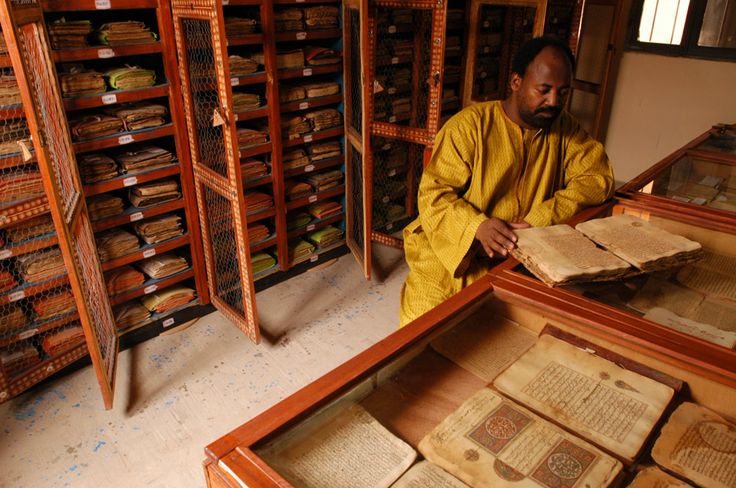
ONE OF THE MANY ANCIENT LIBRARIES IN TIMBUKTU


Of the several things that really bear discussion, the one that concerns me most, in both senses of the word, is The Book. Fewer and fewer books are printed these days because ebooks are becoming more and more popular. This is what the meme says:
 “You say you will never give up the physical book that you hold in your hand and turn the literal pages. I said the same thing about downloading music from iTunes. I wanted my hard copy CD. But I quickly changed my mind when I discovered that I could get albums for half the price without ever leaving home to get the latest music. The same thing will happen with books. You can browse a bookstore online and even read a preview chapter before you buy. And the price is less than half that of a real book. And think of the convenience! Once you start flicking your fingers on the screen instead of the book, you find that you are lost in the story, can't wait to see what happens next, and you forget that you're holding a gadget instead of a book.”


THE LIBRARY OF CONGRESS - SILENCE PLEASE!

Yes, this has to have been written by someone very, very young, and someone who, it seems to me, has had limited exposure to books and culture in general. Playing devil’s advocate here, I’d say the meme author was correct as far as most current fiction and other books that come out in paperback editions. The author was trying to condense the idea into a brief paragraph. To me, the paragraph misses something.

JAY WALKER'S LIBRARY - BOOKS AND THEN SOME


There will always be a market for the beautiful books: the coffee table books, the art, architecture and photography books, the luscious cook books, the oversized children’s books, the special editions and the specially bound books. So: I doubt the news of the demise of the book “within our lifetime”, as the meme declared. William Morris, founder of the Kelmscott Press, would be rolling in his grave. In the future, I’m fairly sure we’ll see many boutique book publishers join the ranks of boutique suppliers of items from craft beers to recreations of historical cuisines.

PENGUIN DROP CAPS


The people at Penguin Books, yes, those folks who gave us some of the first inexpensive paperbacks, have morphed a bit into printing some extraordinary books. Look at these: Penguin Drop Caps, Outside the Lines, and Deluxe Editions. This publisher, among several others, will insure that wonderful books will be printed.

Just before I was ready to post this piece to my blog, I came upon this article from the BBC “Did technology kill the book or give it new life” The article bears out my own ideas. See that?

If nothing else, books are beautiful and, even though their information can be digitized, they hold the wisdom and knowledge of our history in the forms contemporaneous with the writings: books handwritten or machine printed, scrolls, and tablets (from where did you think they borrowed that word for an e-book?). Books are part of what makes humans civilized. Books will always be – just be.


Saturday, April 4, 2015

A PRESENT TO OPEN AGAIN AND AGAIN

With thanks to Mary Engelbreit

Raise your hands, those of you who know Hans Christian Anderson’s tales.  Raise your hands, those of you who loved the 1952 movie Hans Christian Anderson.  Ah, even more! But the movie was a rather romantic version of his life – it wasn’t all music and dancing children. Anderson, who had only a very basic education, had to start earning his living at a very young age. He found his way into the Royal Danish Theatre, and began his writing there. He considered himself a novelist and a playwright, but he is best known to the world for his tales for children. The Ugly Duckling, Thumbelina, The Emperor’s New Clothes, The Princess and the Pea, are certainly the most popular. This year we celebrate Anderson’s 210th birthday.

Wouldn't it be great to get together this many kids to read? But that position, reading on the floor, was never comfortable for me. I wonder what they're reading.

Because Anderson’s tales, many with morals attached, have both taught and delighted children to this day, the International Board on Books for Young People gives a biennial award to authors and illustrators in his name, and his birthday, April 2, has been designated as International Children’s Book Day.

Books are probably the best gifts grandparents can give to the children in their family. They teach, they amuse, they enthrall, they stir the imagination, they keep the kids occupied and quiet – at least or a short time.  Though many books, especially the classics, are available on line, printed books are probably best. A book is a present that can be opened again and again. I am “the book Grandma.” My granddaughters expect them. One year I had one of my younger granddaughters giving me curious looks when I presented her with a large, wrapped box for her birthday. She thought I had given up on the books – but no! I’d pulled a little trick on her: the box was full of books, and she was very relieved.

This is my great-granddaughter, investigating some of the books I gave to her mother yeeeears ago.

Start even the littlest ones with books. Before you blink, before you even realize it, they’ll be grown and will have a large book collection to pass on. This last thing I know for a fact: my oldest granddaughter is now a mother.  She has all the books we’ve given her over at least two decades. Her daughter’s collection is well started. Actual books, once they’ve been read, can sit on a shelf. As a child passes the shelf, or as he searches through the collection, certain books will ‘register’. Whole stories will flit through his mind to be appreciated, perhaps subconsciously, again and again.


C.S. Lewis, the author of The Chronicles of Narnia, a set of books that should be in every child’s library, once said “Someday you will be old enough to start reading fairy tales again.”


Friday, February 6, 2015

ON BUYING E-BOOKS


I’ve finally figured out why I find it ‘itchy’ to buy e-books. I do subscribe to Kindle Buffet and BookSends to glean all the good freebie books each day – I remember the old saying: “For free take, for buy waste time.” So if a freebie looks good, seems to be my kind of reading, no first person, present tense, maybe a wee bit racy, maybe with a good mystery, I’ll add it to the collection.  After all, I can delete it if it proves to be a dud.

But if I buy an e-book and it proves to be a dud I am stuck, I’m out the money, even if it is only 99¢. Moreover, when I’m finished with the electronic book I’ve purchased, and I usually read them at least twice, I can’t donate it to the library to generate a few shekels for the Used Book Sale to entertain or enlighten someone else. I don’t feel at all upset that I can’t pass on something I got for free.

I borrow new books from the library, I usually buy gift books for my granddaughters from Daedalus or Chinaberry, and I buy used books for myself from sources like Thrift Books, the first entry on my laptop’s bookmarks list. My husband sometimes thinks I keep Thrift Books in business. He sees those distinctive orange mailers in the mailbox and says “Uhoh, more books!”  Yes, but these I can pass on. My money at work, as it were.

It has taken me a while to come to this conclusion.  In the year or so that I’ve had the Kindle app on my new laptop I’ve certainly ‘wasted’ money on e-books I purchased. Only a few were duds, and in the main I got my $3.99 or so worth of entertainment from reading the book. But I wasn’t able to pass the book on to someone else – that’s a shame in my book.


We’re told never to judge a book by its cover, but this one below intrigued me. The book itself earned four stars on Amazon, with mixed reviews, mostly favorable. I did like the story and I’ve already read it twice. But I absolutely love the cover. It isn’t your typical bodice-ripper, hands up her skirt type of illustration. It isn’t the current cover – and why do they see the need to change covers on electronic books?  The new one is just a head shot of a pretty male face, one that would never appeal to me.  I keep this book in my Kindle library just to be able to see the cover every once in a while. Odd, I know, but that’s me.


Saturday, October 25, 2014

READING ANOTHER LIFE


Today, according to the Writer’s Almanac, is the birthday of Pulitzer Prize winning novelist Anne Tyler, she of The Accidental Tourist and Breathing Lessons.  Today’s entry included a quote from her: I want to live other lives. I’ve never quite believed that one chance is all I get. Writing is my way of making other chances.”  Aha! That struck a note! Reading is my way of making other chances, of living other lives in other worlds, and, especially now when my traveling days are dwindling down to a precious few, of learning about those worlds.

Strangely enough, when I read another life, I don’t want to read it in the first person, and I don’t want to read it in the present tense. Before I choose a book I have to flip through to the first pages to be sure I’m getting third person, past tense. Nowadays, I can go to Amazon and “Look Inside”. Saves me a lot of aggravation.

When I read another life now, I have certain eras in which I’m interested. Years ago, when I was much younger, I was a Sci-Fi and Fantasy aficionado: Frank Herbert, Robert Heinlein, Anne McCaffrey. I was looking forward. Although I do love a mystery from any age at all, today, l suppose, I’m looking back: anything Medieval, Renaissance, Regency, but nothing Victorian or later. 
Why? I’ll tell you: I don’t know! 


Friday, April 19, 2013

TO READ PERCHANCE TO DREAM

Unaccustomed as I am to public speaking - I’ve never addressed more than fifteen people and that was at a club meeting - early this morning I found myself dreaming that I was speaking at a high school graduation. When I woke up I remembered a lot of that short but vivid dream; remembered enough that I said to myself: “Self, you ought to write this down.”


I remembered we were sitting in a stretch limo, and I was introducing one Superintendent of Schools to another – I don’t even know any Superintendents of Schools!  I was wearing a white, knee length outfit – pleated skirt and navy trimmed sailor-boy top – and though I’ve had an outfit like that, mine was in pink crepe. And I suddenly realized that I had on knee high stockings and everyone would see the tops when I got up on the stage, so I was scrambling to get them off, but then my feet felt icky in my shoes. The high school was in Pennsylvania – I went to high school in New York.  I was up on stage, talking to the audience and trying to get them seated, explaining that there would be a delay in everything because the backstage clock was ten minutes behind the one in the auditorium.  And then I woke up. I wonder where that dream came from. I didn’t read before bed last night, so this dream segued right into the essay I’d already written:


I love to dream.  I usually have great dreams, but they seem to depend on what I read just before bed. I’m not much of a movie-goer, but when I’ve seen a movie that evening it too, of course, influences my dreams. I learned early on never to watch a horror movie – they make for nightmares – as do horror novels. Stephen King is a great writer, but I can’t read any more of his stuff.  The Shining stayed with me for days.
 
Several evenings I’ve played a game or two of Solitaire on my laptop and I dreamt cards! Not any Alice in Wonderland dream of card games, no, I’m just piling one correct card upon another, boring, boring, red queen on black king, black six on red seven. No good, no good! If I’ve had no chance to read that day my dreams seem to fall back on one of several ‘themes’ I’ve reencountered over the years.


A little bit of self-psychoanalysis here?  Do I love to read because I love to dream?  Maybe. I’ve been surrounded by books all my life. While I do read
non-fiction, I try not to read it last thing before I go to bed.
I’ve read all of authors such as Robertson Davies, Dorothy Dunnett, Diana Gabaldon, Robert Heinlein, P.D. James, Anne McCaffrey, Nora Roberts, and John Steinbeck (in alphabetical order because I like them all).  I’ve read some, not all, of many others.  I estimate that I read 200 to 250, and maybe more books every year.  They contribute to wonderful dreams.
During one teenage summer vacation of about ten weeks – I think it was the summer between my sophomore and junior years, I know it was before I had a summer job - I set out to keep track of the number of books I read: the total was 54. All were classics from the family library.  The longest: War and Peace!  The shortest: oooh, I don’t remember – but I read lots of Twain, the Bronte sisters, some poetry, Lust for Life, some Dickens – I really didn’t care for Dickens – and many more.  It was that summer that I began to notice that my reading found itself reiterated, usually very strangely, in my dreams.  I’ve been a fiction junkie ever since.
 

Friday, March 15, 2013

I BUY BOOKS...

   Or: my answer to Mr. Seinfeld


I don’t smoke or drink or even chew gum. My vice: I buy books. Many are worthy of any good library, many, some of you might think, are not.  Recent purchases in the former category include Jacques Barzun’s From Dawn to Decadence: 1500 to the Present, and the Merriam Webster New Book of Word Histories. The latter? Well, let’s just call them Fiction: Romances, Mysteries, Romance Mysteries – I’ve a long list of favorite authors.
 
Since 1990 when I stopped lumping in book money with the rest of our entertainment expenditures, I’ve spent just over $14,000.00 on books, many of them used. Egad! That’s a nice chunk of change.  I’m sure the lifetime total would be nicely impressive too, and I delight in every dollar’s worth.
 
I was reading Theodore Dalrymple’s essay Why second-hand bookshops are just my type, and I came upon the telling of a bibliomaniac whose library was sold after his death for only a third of what he’d paid for the massive collection. I sold off my college text books – about twenty years later - but I can’t imagine selling my books now. I’ve always given them away when I was finished with them. I’ve read many of my books four or five times, but usually when I’ve read a book twice – or have gotten only part way into a real dud – it goes into the bag to be taken to the library for the sale room.  Sell them? I’ve not got the time: I’m reading!
Dalrymple’s essay mourns the passing of second-hand bookshops. I’ve rarely had the pleasure of browsing in a second-hand bookshop.* I do now have the pleasure of browsing in second-hand book sites on line. My favorite is Thrift Books, and Britain’s Awesome Books is pretty well that: awesome.
 
Really, really esoteric volumes can sometimes be found, used, of course, at Amazon – but then, what can’t you find at Amazon?  I do browse the shelves of the sale room at the library – always going with book lists in hand to be sure I’ve not read that one before, always looking for new treasures. (And library sale rooms are great sources for children’s books. I’ve got on hand new birthday and Christmas books for my granddaughters will into 2016, but used books are great to hand out throughout the year for un-birthdays and such.) 
 
 
I don’t know if you’ll think this good or bad, but though I’ve always belonged to the library wherever we lived and occasionally do check out books, I’d really rather own a book than borrow it. If it is mine I can take as long as I want to read it: though I read many books in a week, it gives me the itch to have a time limit on my reading.  If it is mine I am happy to let it just sit in my stack of to-be-read and enjoy its being there.
 
In one paragraph, talking about the pleasures of finding markings and various papers and bookmarks in used books, Dalrymple says “there is no substitute for being able to hold the physical book in one’s hand.” I agree wholeheartedly – but for another reason on another plane: I don’t think I’ll ever be comfortable with an electronic book.  A good friend of mine has shown me the wonders of her iPad, and how she can enlarge the type, and how it remembers where she left off, and all the other delights of electronic reading.  Not for me. I want to be able to flip back to that remembered reference to a certain character or place – and I remember it was on the left hand page about two inches from the bottom. Yes, there it is. I remembered the ‘landmarks’.  Can’t do that with an electronic book. 
 
This is just a fraction of th books I once owned. I keep them
and all my litle dustables in our bedroom - this way none of it
has to be dusted very often.
I want to hold the book and not have to be too careful not to drop it in the toilet if I’m in a bathroom reading session – though there I usually read magazines. I want to refer every once in a while to the jacket’s cover picture or inside blurb and bio.  I want to see my books – especially the ones I’ve kept and reread for years.  Just seeing the books on the shelf gives me a fleeting remembrance of the story. I can’t get that feeling with an electronic device.
 
Books are neat and compact, easier to collect and store and dust (though I rarely do) than say salt and pepper shakers or automobilia. Yes, for many reasons on many levels, I’ll stick to books as my vice of choice.
 
 
*but I love pictures of them – so higgledy-piggledy, stacks and stacks.  As the bibliophile’s lament goes: So many books, so little time. 

Tuesday, March 12, 2013

OBSESSION WITH BOOKS


“What is this obsession people have with books? They put them in their houses like they're trophies. What do you need it for after you read it?”
                           ― Jerry Seinfeld


In answer to Mr. Seinfeld, I say “read my post this coming Friday.”

Friday, January 11, 2013

MY GREAT AMERICAN NOVEL


        Well, I don’t think I’ll ever be able to write “the Great American Novel.” There are so many already, and I think I’ve read most of them. There’s my problem: I love to read.  What with life and everything that goes with it, the saying “so many books, so little time” certainly applies to me.  My husband’s always commenting: “never mind reading, write one!”  Yeah, sure!   

 
No, not this one. I'm not too sure, never having read it,
how great it might be.

       I must admit that on certain sleepless nights I have thought about writing something longer than one of these essays, but by the time I really got into the story I was asleep, and by the time I woke up the whole thing was forgotten.  Now I keep a pad and lighted pen (a great invention!) right by the bed.  Unfortunately for the world, it’s too late to retrieve my magnum opus from the depths of dreamland.  A few words jotted down fairly legibly are enough to fuel an essay, but would never be enough to start a fire under a novel.  However, the other night I had an idea: a generic starter for several novels: “Grandma grounded you, did she?”
       Or was it Grandpa, or Dad who did?  Who is speaking?  Mom, a brother, Auntie Em? Who is being spoken to? An eighteen-year-old, an eight-year-old?  Where are they?  What time of day? What season?  Above all, what was done wrong?  What are the consequences?  The permutations of the situation are endless.
      I’m guessing that that is how many of these modern churners-out-of-novels do it: they use a formula.  Never mind the old “boy meets girl, boy loses girl, boy gets girl” shtick.  Too easy.  They must be using something like my basic generic starter, playing around with the characters and circumstances, and they’re getting rich doing it.  Egad!  There must be starters for everything from modern romances to horror tales to spy novels.
 
     C.S. Forester wrote:"A man who writes for a living does not have to go anywhere in particular, and he could rarely afford to if he wanted.” Years ago the lesson was “write what you know.” I think I could have happily learned to write what I knew while traveling the world. If I’d wanted to send the characters to Hong Kong or Stockholm, I’d just have had to check it out first.  Couldn’t have the characters wandering down streets that aren’t there or eating in restaurants that don’t exist, could I?  All that lovely travel would all be in the name of research, and today it would be tax deductible. Just think of the sight-seeing tours, the dining out, the shopping. Oh, the possibilities! 

    I’ve gleaned a few essays from my travels, but not the great novel. Frankly, I wasn’t even thinking about a novel when I was traveling. I realize I’ve always been destined to be a reader. What would authors do without folks like me?


P.S. Feel free to use my generic starter.
One never knows what you might write!