Friday, March 18, 2016

THE FIRST DAYS OF SPRING

Here's another article I wrote for our community magazine - this one was is this month's issue. 


All over the world, Spring, is the time of rebirth celebration. The two major monotheistic religions in this country, Christianity and Judaism, celebrate major observances, both moveable feasts, in this season. Frequently, these celebrations coincide, but this year they are almost a month apart. Easter Week, the Paschal remembrance, comes earliest this year from Palm Sunday, which happens to be the first day of Spring, on March 20th, to Easter on the 27th; Passover, the Paschal remembrance, begins with the Passover Seder, this year on April 22nd until the Last Day on the 30th. Both religions use the word Paschal as one of the names for the occasion.

Jesus of Nazareth, a carpenter, was a pious Jew. The story of his life, from his birth to his death, is contained in the stories of the books of the New Testament, the basis of Christian theology. They tell us that in his thirties, Jesus began a life of public teaching, spreading a message of God’s love, love for our fellow man, and of God’s forgiveness. History, they say, is written by the winners. For this story, it was written by Jesus’ followers, people who sought to spread his teachings.

Though it is questionable that this pious Jew ever claimed to be God or God’s son, he did spread a very popular message that the stern and unforgiving God of the Old Testament was also a loving, forgiving God. The religious leaders of the time sought to quell his teachings and discourage his followers. Citing his claim to be God, the leaders enlisted the aid of the Roman governor, one Pontius Pilate, who had Jesus arrested and executed. The story tells of Jesus’ arrest and execution, and of his rising from the dead and ascension on what is now called Easter Sunday. When was Jesus arrested? The night after he and his disciples had what was to be his Last Supper, the Passover Seder. The Passover Seder is a ritual commemorating the Jews’ Exodus to freedom from slavery in Egypt after they had been passed over by the Angel of Death who visited the Ten Plagues on the Egyptians.

In essence, the Christians associate the resurrection of Jesus with the rebirth of the year. They use new life, eggs, baby animals like chick, bunnies, or lambs, fresh spring flowers, and new green grass as symbols of rebirth. They are incorporated, in many forms, into the meals and treats that celebrate
Easter Sunday and the end of the solemn weeks of Lent.

The Jewish Seder is a meal of remembrance. It is a meal that, in the many foods that are served, remembers their slavery and final freedom. There is a plate of six special foods that are eaten, one of which is the bitter herbs, sometimes horseradish, romaine, or endive, that recall the bitter days of slavery. The meal includes unleavened bread, matzoh, to recall that their flight from Egypt was so abrupt that they had no time to let their bread rise. Roast meats recall the lamb sacrificed at the Temple in Jerusalem. During the long meal, the story of the Exodus is read, and many other foods eaten and rituals performed to recall and reinforce the memories and the importance of the story.


However you celebrate the coming of Spring, I wish you all a wonderful season.


Saturday, March 12, 2016

PINEAPPLE PANCAKES FOR TWO SENIORS


Last Thursday I bought some delicious, fresh pineapple. This morning I thought I'd mince up some of it - maybe 1/2 cup or so, and add it to my regular recipe for pancakes. It was, if I do say so myself, delicious!

I/s a cup of pineapple, or more?


I don't always add fruit, but this is a recipe I use every Saturday. It’s great for both waffles and pancakes, and takes little time to whip up. Of course, it serves 2. Here goes:

Chop up about 1/2 cup or more of fresh pineapple.

Preheat your griddle, and meanwhile

In a 2-cup Pyrex measuring cup or similar thing, add and whisk together well:
½ cup milk
1 egg
1 Tbsp. sugar
2 Tbsp. vegetable oil
Pinch of salt

After mixing that, put in on top of it

½ cup flour, then on top of that
1½ tsp. baking powder –

With your fork or whisk, sort of swirl the baking powder into the top of the flour to mix them a bit, then mix it all into the liquid until it is fairly lump free. 

Stir in the 'minced' pineapple.

Voila: your batter is ready. Just enough for two Seniors. Double or triple as needed.


I was a bit on the messy side this morning, but
the pancakes were excellent.

Thursday, March 10, 2016

WHAT HATH BELL WROUGHT?


Here's an article I wrote for the community magazine. It's nice that I can always use a piece, even if they don't. That's the nice thing about a blog. I do think it amazing how far the phone has come since that first call.

You couldn't carry this one in your pocket.

It was on March 10, 1876, a mere 140 years ago, that Alexander Graham Bell made the first phone call: “Mr. Watson, come here, I want to see you.” That one was just from room to room. Knowing what we know now about how the telephone has changed, and changed our lives, Bell probably should have used the same message sent over the first telegraph line: “What hath God wrought?”
The telephone: people spend hours talking to one another. Gian Carlo Menotti felt it worthy of a short, two-character comic opera in 1947. In The Telephone, a suitor tries desperately to propose to his girl, all the while she has almost endless conversations on the phone.

Menotti's opera
People rarely have a party line these days, but after commercial switchboards were introduced they were the least expensive way to phone. Of course, your neighbors could and sometimes did listen in on your conversations, but you listened in on theirs too. You can just picture a farm wife standing by the wall phone, listening in to what’s happening in the county. Private lines are now almost a requirement. In many households there is a private number for each family member.

German telephone operators around 1920 - that's my Great aunt Josephine on the far right -
they had to speak English as well as their native German 

It sometimes took what seemed like ages for a radio-telephone call to connect overseas, but once a transatlantic telephone cable was installed it became an almost everyday occurrence. Today, with satellite transmission, we think nothing of staying in touch when we are travelling overseas. An international Subscriber Identification Number, a SIM card, can be exchanged in our phones so that we can call to anywhere from anywhere.

"The lady of the house speaking!"
Hyacinth and her Princess Phone

The parents of teenage girls despaired when the Princess Phone was introduced by the Bell System in 1959. The phone was marketed to women; men and boys used it only as a matter of necessity. Teenage girls spent hours talking to each other, after they’d seen each other in school all day. Today those parents are probably thanking their lucky stars that it was only that hard-wired phone: now there are portable communications and computer devices of all types for parents to contend with.

The landline phone went from cumbersome, no dial, just pick it up and talk to the switchboard operator, to rotary dial, to the touch pad in use now. We still call it a ‘phone’, but it has morphed from a hard-wired talking device into a mobile talking/texting/on-line communications device with dozens of apps and games, all held in the palm of the hand.
  
I
Where do we go from here?


Friday, March 4, 2016

A POEM FOR MARCH - BOOTS

I tell you, it ain't easy findin' a picture to go with Boots.  I can hear 'em, but I can't see 'em.


March! Where did it come from? I'm four days into it, dinner time has come and gone, and I just realized I'd missed posting my poem as I usually do before breakfast on the first of the month. I must admit I've been reading up a storm these past few days, so that's my excuse reason.
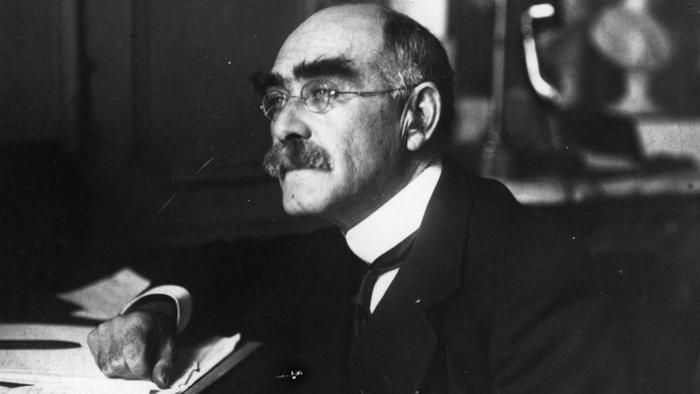
Boots! I had read The Jungle Book, but this was my first introduction to Rudyard Kipling’s poetry. In my mind’s ear I can still hear my English teacher, Mr. Ross, reciting this to the class. After a while I could hear the cadence as the troops marched up and down. That reading is one of the vivid memories I have of those high school years. Marching: apt for March, is it not?

Boots        by Rudyard Kipling

INFANTRY COLUMNS

We're foot—slog—slog—slog—sloggin' over Africa —
Foot—foot—foot—foot—sloggin' over Africa —
(Boots—boots—boots—boots—movin' up an' down again!)
                There's no discharge in the war!

Seven—six—eleven—five—nine-an'-twenty mile to-day —
Four—eleven—seventeen—thirty-two the day before —
(Boots—boots—boots—boots—movin' up an' down again!)
                There's no discharge in the war!

Don't—don't—don't—don't—look at what's in front of you.
(Boots—boots—boots—boots—movin' up an' down again);
Men—men—men—men—men go mad with watchin' em,
                An' there's no discharge in the war!

Try—try—try—try—to think o' something different —
Oh—my—God—keep—me from goin' lunatic!
(Boots—boots—boots—boots—movin' up an' down again!)
                There's no discharge in the war!

Count—count—count—count—the bullets in the bandoliers.
If—your—eyes—drop—they will get atop o' you!
(Boots—boots—boots—boots—movin' up an' down again) —
                There's no discharge in the war!

We—can—stick—out—'unger, thirst, an' weariness,
But—not—not—not—not the chronic sight of 'em —
Boot—boots—boots—boots—movin' up an' down again,
                An' there's no discharge in the war!

'Taint—so—bad—by—day because o' company,
But night—brings—long—strings—o' forty thousand million
Boots—boots—boots—boots—movin' up an' down again.
                There's no discharge in the war!

I—'ave—marched—six—weeks in 'Ell an' certify
It—is—not—fire—devils, dark, or anything,
But boots—boots—boots—boots—movin' up an' down again,
                An' there's no discharge in the war!


Friday, February 26, 2016

POPCORN


According to The Writer’s Almanac for February 22nd “On this date in 1630, Quadaquine, brother of Massasoit, leader of the Wampanoag tribe, introduced popcorn to the English colonists.”  Scientific evidence has shown that natives all over the Americas had been consuming popcorn for centuries. I’m delighted that we still have it – it is one of my favorite snacks. Popcorn is inexpensive – unless you go the gourmet, chi-chi flavors route, and is relatively low in calories.


Don’t give me bacon-cheddar or jalapeño, buffalo ranch, pumpkin, or cinnamon, or any of those other flavors. For me, popcorn is meant to be buttered, as in theater popcorn, kettle corn and lightly sweet, or, the ultimate indulgence: Cracker Jacks. To me, that’s heaven in a box. (Yeah, and I remember when the prize in the box was worth saving - for a few days at least, until my mother probably tossed it.)


Friday, February 19, 2016

WALKING BEHIND


One day in December, Jacqueline Donnelley, at her wonderful blog Saratoga Woods and Waterways, titled her blog Walking With My Husband, and included this poem:

Bogliasco
                              by Robert Polito

I’m always running ahead of my life,
The way when we walk you are always

Three, fifteen, forty steps behind
Taking a picture, or inspecting

A bottlebrush tree, a cornice, the sea
As it breaks white on the striated rock,

As though I can’t dare look, and
I’m always running away from myself

The way when we walk you are always
Asking me to slow down, and what will happen

When one of us dies, and, if it’s me first,
There’s no one’s back in our photos anymore.


The poem struck home for me. So many times I’ve lagged behind, taking pictures of everything and anything, including my husband’s retreating back. I was always asking him to slow down. Now, time has taken its toll and he toddles along behind me. I wait for him to catch up. I wait patiently. I would wait forever for that dear man.


Wednesday, February 17, 2016

THE 500


What’s in a name? Today I ask what’s in a number - the number 500.

       The Fortune 500
       500 Days of Summer
       S & P 500 Index
       The Daytona 500
       The Indianapolis 500
       Cinque Cento   (I love this one!)


A 1957 Fiat 500 - Cinque Cento
I'd love to have one now!

And – this is my 500th post. Blogger keeps track of these things, as I learned when I did my 400th post. I’ve been at this blog since October 2010. That’s quite a while as blogs go. I did have one years ago, at the turn of the century!, on the old Netscape, but it folded when that particular service did and I wasn't inclined to begin again for a long while. I'm so glad I started again. I really enjoy the writing and the research, memories, and musings that go along with it all.

Today I send love and Zen Hugs to all my regular readers – as always, I know you know who you are – and I hope I can keep on keepin’ on with this blog for a long while to come. 


Friday, February 12, 2016

EAT LIKE A KING

With a modification or two, this piece debuted in the February issue of our community magazine, Living @ Sun City Carolina Lakes.  I thought my other readers might enjoy it too.


Keep Calm!

There is a saying to this effect:
    Breakfast like a King
    Lunch like a Prince
    Dine like a pauper.

There may be something to that adage because recent studies have shown that reversing the usual way we approach meals, having our largest meal in the morning, is beneficial in several ways. The daily count of calories is the same, we just reverse the portion sizes. For adults it means being better able to manage weight: your body has had a big meal, is satisfied, and isn’t sending out chemical signals that ask for more. For children it means having a good start with protein for alertness and concentration at school. For seniors, just as for the children, it means enhanced memory, cognitive skills, and attention span, plus the energy to have a satisfying day.

While it isn’t the “cruelest month”, February is still one of the coldest, and the perfect month to be National Hot Breakfast Month. Unlike many foodie months that are sponsored by manufacturers, this one is sponsored by the U.S. Department of Agriculture. What better way to start eating like a king than with a good breakfast. Consider the European breakfast – no, not the big British “fry-up” - that’s a heart attack on a plate! If you’ve ever stayed in one of the smaller accommodations on the continent, you’ll know what a kingly breakfast can mean. There’s usually a spread, in Scandinavia a smorgasbord, of meats, eggs, cheeses, yoghurt, fresh fruit, and hearty cereals. When in Norway though, be aware of just what is in each of those pitchers: The Norwegians like their cereal with hot buttermilk.

The idea now is “Rise and Dine.” Take a few minutes each evening to put your piece of fruit, your cup of yoghurt, your bag of granola or trail mix, your muffin, or your hardboiled egg right where you can grab it in the front of the fridge. Yes it will be cold, but it’s better than that bagel or a pop-tart. If you have time for a pop-tart you have time to eat properly. (Yes Mother!) 

Challenge yourself to have at least three hot breakfasts each week. Get creative and think of ways to combine and warm those foods from the smorgasbord into a tasty meal you’ll enjoy. Get your morning protein – actually, you should have some protein at every meal – eggs, lean meats, yoghurt, and cheeses of all kinds. Have juice to wash down your meds and vitamins, a piece of fresh fruit for sweetness. You can grab and go with a banana or an apple, and as was the line on the old airline commercials: “coffee, tea, or milk.”
Many of us Seniors do take the time for a leisurely, and we hope healthy, breakfast. But there are many who rise and hurry off to run, or to the pool, or to a job or a meeting. With a bit of proper prior planning you can still have a more substantial breakfast than just grabbing a bagel and questionable cup of coffee at a coffee hangout.

There are always handy breakfast places nearby, but the average cost of breakfast made at home is only on quarter of the same breakfast out – simple math: that’s four at home for the price of one out. Breakfast out means gas and mileage on the car, much more time to get there and back, not to mention that even if you use the drive-up window, you have to be at least fairly presentable from the waist up.


Just in case you were wondering, February is also National Snack Food Month, but don’t celebrate that one too enthusiastically, you’ll undo all the good you do eating breakfast like a king.


Wednesday, February 10, 2016

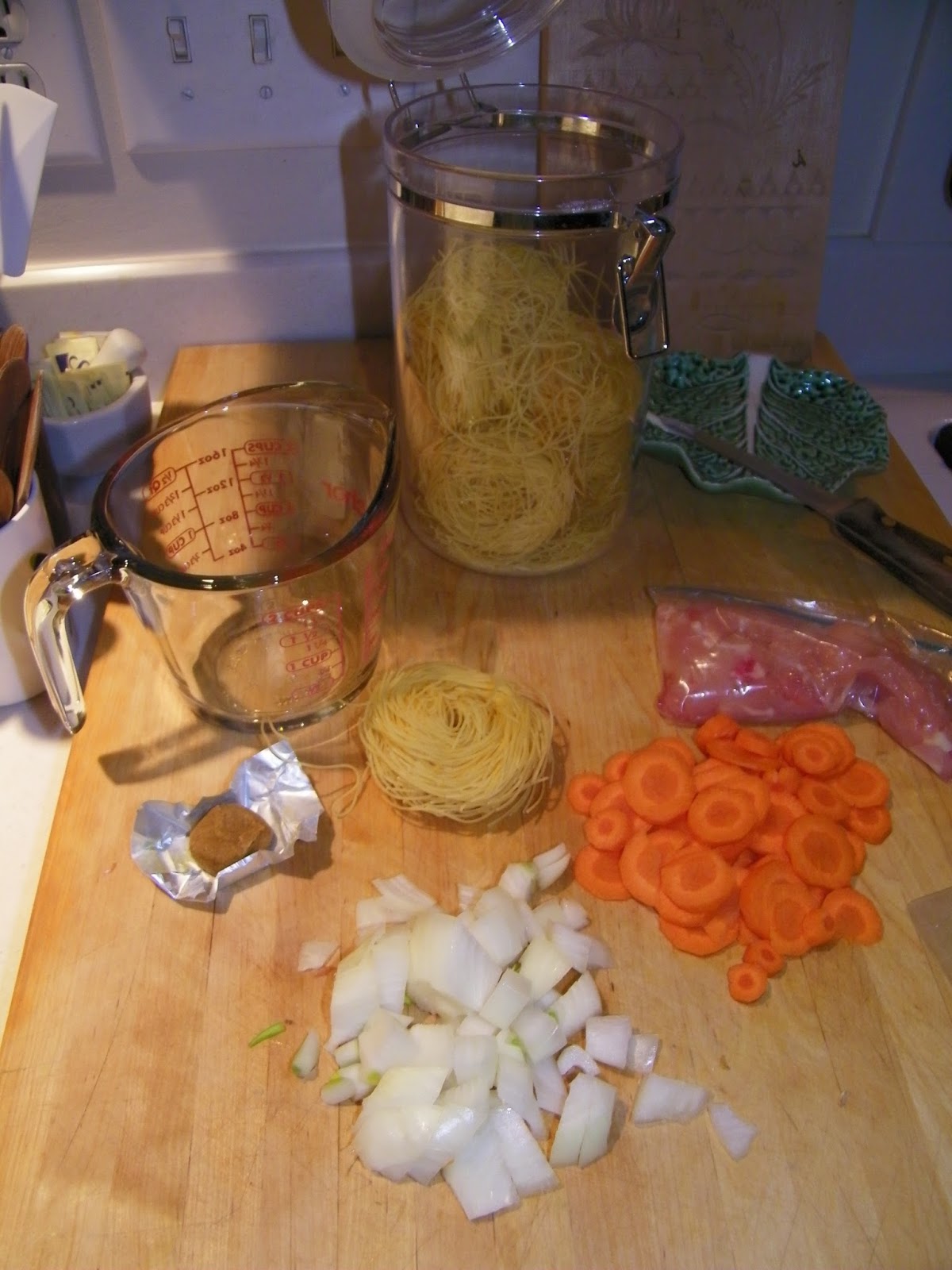
QUICK CHICKEN NOODLE SOUP FOR TWO


I buy my chicken breasts at Harris Teeter. At the current price of $1.99 per pound, they can’t bettered for price. I buy six or eight at a time, clean them up, and freeze them individually in sandwich bags. During the cleanup, I can salvage at least an ounce of good meat from each breast.  I cut this extra into smaller bits, bag it, freeze it, and save it for soup. I’ve developed a great recipe for chicken noodle soup for two. The longest thing about this recipe is the time it takes the chicken to thaw. 


Ingredients:

2 Tbsp. butter
6 to 8 ounces of chicken bits
1 small onion, diced

3 cups of water
1 Knorr or Maggi chicken bouillon tablet, crumbled
1 Tbsp. chopped fresh – or fresh frozen – parsley
¼ tsp. of your choice of herbs: rosemary, sage, thyme

1 small to medium carrot, peeled and sliced thin
1 nest of angel hair pasta
Salt and pepper


In your soup pot, sauté the chicken bits and diced onion in the butter until the chicken turns white. -- Add the water, crumbled bouillon tablet, parsley, and herbs. Bring the whole thing to a boil. -- Break the pasta nest in half, and add it and the carrots to the pot. Bring it all back to the boil and time it for 10 minutes.


That’s it!  Serve it up with some crackers and enjoy.


Friday, February 5, 2016

THE PATH OF LEAST RESISTANCE


My mother and I rarely talked about our lives. She told me little about her childhood. Little, that is, that would make me understand why she did a lot of what she did. I did know, and it’s the first and only thing that jumps to mind, that she liked to have her birthday remembered – and my father wasn’t too good at remembering. He was always last-minute-Bud, writing up a poem for her when he remembered that he forgot. Her birthday was December 26th. She never got birthday presents from her parents: “Oh, Dorothy, you got presents yesterday, you don’t need any today.” As kids, we didn’t know this, but once we learned we sure did make her birthday special as we could. Years later, my sister’s second son was born on December 24th. You can be sure my mother made a special deal of it.

Now that I think of it, I may be a lot like my mother. I have very few dramatic or even interesting tales to tell about my childhood and later years spent at home – or anywhere for that matter. Neither did my mother. I now believe that both she and I, smart as we were, just took life as it came to us, never really pre-planning what we would do. It’s not that we took paths of least resistance, we took paths offered to us. Very few times did I have to make a great decision in my life. Maybe twice. Once when I had to make the decision not to go back to college after two years. I felt I was getting a fine education in nothing useful to me career-wise. The other time was when, after the banns had been announced, I decided not to marry my fiancé. I loved him but I did not particularly like the attitude he began to show that he would dictate all rules for our marriage. Both turned out to be very good decisions. Perhaps not “all the difference” made by choosing The Road Not Taken – my favorite poem, by the way – but they brought me to where I am now. In that “now” I am very content.


Wednesday, February 3, 2016

WINTER STARS - A POEM FOR FEBRUARY FIRST

Yes, my poem for February first, and I forgot to post it. No excuses - I just totally forgot it. But here it is, a really lovely poem. Sara Teasdale watched Orion. On clear mornings,I've been delighting in the current display of the planets, Mercury, Venus, Saturn, Mars, and Jupiter, as I take my early walk. I can remember their order by the mnemonic I created for myself: My Very Sweet Mr. Johnston - my husband, of course.


Years go, dreams go, and youth goes too - meaningful words for this Senior.


Winter Stars

I went out at night alone;
 The young blood flowing beyond the sea
Seemed to have drenched my spirit’s wings—
 I bore my sorrow heavily.

But when I lifted up my head
 From shadows shaken on the snow,
I saw Orion in the east
 Burn steadily as long ago.

From windows in my father’s house,
 Dreaming my dreams on winter nights,
I watched Orion as a girl
 Above another city’s lights.

Years go, dreams go, and youth goes too,
 The world’s heart breaks beneath its wars,
All things are changed, save in the east
 The faithful beauty of the stars.


Friday, January 29, 2016

THE TROUBLE WITH TISSUES


Facial tissues are the bane of my existence these days. My husband is snotty! Not a snot, just snotty. It’s a long story – over forty years long.

For years, my husband carried a pocket bandana – not a handkerchief, no, he needed a big boy for his big blows. As I wrote in The Sneeze, he makes a great noise when he sneezes – same thing when he blows his nose. He had, still has, quite a collection of bandanas, but he no longer likes having a – how shall I put this delicately – a “wet” handkerchief in his pocket. In a way, I welcomed this change. You have never lived until you’ve hand-washed snotty bandanas while you’re traveling away from home. I did that for the first for the first few trips and then I rebelled. Perhaps that was the germ of the idea for him to use tissues.

Now he prefers to use Kleenex. Not just any facial tissue, the others are, too him, too scratchy, too thin, and prone to blow-through. He likes tissues: one blow and he can throw it away. I rarely encounter a snotty tissue these days, but with great regularity I get a laundry-full of Kleenex remnants. Why? Because he leaves the clean tissues in his pockets. He stocks up every morning. It’s a loud “aaarrrg!” when I open up the washer and see tissue bits all over everything. I try to get as much of it off as I can, but a lot winds up in the dryer and on the dryer filter – and all over the floor. It’s one of my earthly trials.

So, who’s the dummy here, him or me?  Me, of course, because only in recent months have I thought to go through his pockets before I throw the shirts or jeans into the washer. Live and learn – but why did it take me so long?

I do realize that I am not the only one with this problem - this laundress thought to take a picture of the mess.
It's such fun picking all the schnibs off of everything - not!


Friday, January 22, 2016

THE BROTHERS GRIMM


We are now somewhere right between the birthdays of the brothers Grimm, Jacob’s on January 4th, and Wilhelm’s on February 24th. Give or take the year, both are having their 230th birthdays.


Today, Grimms’ Fairy Tales don’t seem so grim, but that’s probably because most of us know the fairly innocuous Disney versions. Sleeping Beauty, Cinderella, Snow White, and even The Brave Little Taylor, came to us complete with malevolent fairies, ugly stepsisters, witches, and giants, but they were soon dispatched in Technicolor and with catchy tunes. Reading the original versions, people today might be shocked at the violence in the old folk tales, but then again, after living in the midst of such movies as Nightmare on Elm Street and The Exorcist, maybe not.

The Grimms volunteered to collect local oral folktales for a friend’s project. They wound up writing them in collections of their own, eventually including over two hundred tales, and gradually toning down some of the stark images in the stories they heard. Modern versions, including operas, films, plays, and, of course, children’s books are mostly low key and very entertaining, but are not at all the moral tales and life lessons originally intended to teach the young.


Compare, for instance, Arthur Rackham’s illustrations for Cinderella and Snow White in 1900 for a volume of Fairy Tales of the Brothers Grimm, to the Disney illustrations.  As the illustrations became simpler, rounder, with less detail and more color, so too did the stories become relatively sanitized over the years. The morals of the stories are still in place, but they warn more than scare.


The Seven Dwarfs are certainly less intimidating
in the Disney version.


Friday, January 15, 2016

HALLUCINOGENIC INSTANT


In one of her Brunetti books, Death in a Strange Country, Donna Leon has her hero, Commissario Brunetti, think of the answer in a ‘hallucinogenic instant’. It is the “aha” moment, as Webster’s defines it: a moment of sudden realization, inspiration, insight, recognition, or comprehension. It can also be the instant, usually traumatic, when your life flashes before your eyes.   

On a regular basis, nine times out of ten, we just think of what has to be done and we do it. The hallucinogenic instant comes at that tenth time, the time when we are desperate. When we’ve got to solve the problem, do or die.

It also comes when, as noted, our life flashes before our eyes.  This has happened to me. Once, on an excruciating January day after a night of constant snow followed by freezing rain, I was dumb enough to try to get to work on the Long Island Expressway. Wrong decision! It wasn’t essential that I get there. Cresting a hill, the wind took my car and sent it sailing into another car that had had the same experience. Crash! But between the time the wind took the car and the time I crashed, time itself slowed down for me. I even had time to think about what I was thinking. I never thought I was going to die, but I did get a quick review of things past. Eerie, to say the least. I was right near the exit I would have taken, so I left the car and trudged through the ice and knee-deep snow to get to work and start the recovery process. As I walked, I thought more about the experience. It was nasty to be in the accident, but in a way I was delighted to then be among those whose life had flashed before their eyes and lived to tell the tale.


Friday, January 8, 2016

PREJUDICES


Prejudices: we like to think we’ve none, but we’ve all got them tucked away here and there. I believe that we think that when we’ve overcome our parents’ prejudices we are free of it all – ‘taint so. And really, sometimes I think we think we’re prejudiced when maybe ‘prejudice’ wrong word. I do not “pre-judge” people on looks, so I am supposing that I am not prejudiced. But then if someone opens their mouth and out comes something I don’t like or is just not correct – bingo! – the shutters go down. I love this quote from Maya Angelou: “When people show you who they are, believe them.” So maybe I’m not prejudiced, I’m postjudiced.


Friday, January 1, 2016

THE SONG OF WANDERING ANGUS

Today we start the new year. I wish all of my readers a happy, healthy, interesting 2016


The silver apples of the moon...

This poem is a lovely, dreamy thing to me, reminiscent of Robert Frost and Lewis Carroll, and it paints a watercolor picture in my mind. In my second year in college I took an unusual course in literature. I think the college was catering to this particular professor because the year was two semesters of her personal favorites: Chaucer and Yeats. Could there be and two writers more different?  I did enjoy both courses, except perhaps for the required Middle English language lab sessions, and this was one of my favorite of Yeats poems.


     The Song of Wandering Angus

  
I went out to the hazel wood,
Because a fire was in my head,
And cut and peeled a hazel wand,
And hooked a berry to a thread;
And when white moths were on the wing,
And moth-like stars were flickering out,
I dropped the berry in a stream
And caught a little silver trout.

When I had laid it on the floor
I went to blow the fire aflame,
But something rustled on the floor,
And some one called me by my name:
It had become a glimmering girl
With apple blossom in her hair
Who called me by name and ran
And faded through the brightening air.

Though I am old with wandering
Through hollow lands and hilly lands,
I will find out where she has gone,
And kiss her lips and take her hands;
And walk among long dangled grass,
And pluck till time and times are done
The silver apples of the moon,
The golden apples of the sun.


Wednesday, December 30, 2015

KIPLING AND HISTORY


Love those eyebrows!

Today is the 150th Birthday of Rudyard Kipling, the writer of poems, short stories, and novels loved around the world. I love Kipling’s works. Jungle Books, Gunga Din, Boots. They’re not just for kids, as many people believe. I enjoy them to this day. I was thrilled to visit his home, Bateman’s, in England. I guess you could say he is one of my favorite poets and writers. I read of his birthday this morning on The Writer’s Almanac, one of my best sources for writing ideas. As usual, they ended the piece with a quote. This one really made sense to me:

      "If history were taught in the form of stories, it would never be forgotten."

True, true, true!  I’ve been saying for years that I’ve learned more history from my adult reading than I ever did in school. (Well, let’s hope so! When you stop learning you might as well curl up and die.) And it is soooo much more interesting. I’ve written about this before – here – but this week it really strikes home. 

We spent our Christmas holiday up in New York with some special people who bought our house when we moved south. I had left books for their future reading – about 12’ worth – and this trip I brought all the books back south with me. The house is being remodeled, and that shelf will hold other things.
I spent a lot of yesterday sorting out the books, deciding what ones to keep, and just delighting in seeing them again. The majority of them are historical novels – Middle Ages, Renaissance, and so on. Europe, India, America, and do on – with some Brit mysteries too, of course.
Many of the books, such as Dorothy Dunnett’s The Lymond Chronicles, a series of six historical novels set in the mid 1500’s, are some of the sources of my historical education. All are a source of some little tidbit of information that I’ve tucked into the grab bag of my memory.  One never knows when one will need to know that a sovereign is a pound, or a crown is 5 shillings, or that a flock of crows is a murder.

Try a historical novel, history in the form of a story – you’ll learn a lot, and enjoy it all too.


Friday, December 25, 2015

A VERY MERRY PC CHRISTMAS


I am going to be non-PC and wish every one of you a very Merry Christmas. I know, I know, it is politically correct to say Happy Holidays, but today is Christmas. It is also the birthday of a dear friend of mine who happens to be Jewish. She and that Jewish kid from Bethlehem share the same birthday.     

Years ago, our family had wonderful next-door neighbors. They were Jewish. He was an excellent doctor, one of the best in town. One year, the year I remember because of what he said, a Christian patient sent him a card with a nativity scene on it. Someone at the gathering saw the card and was very surprised to see it there.  “Not at all,” said our neighbor, “after all, they were a good Jewish family.”

See that? There’s PC, politically correct, and then there’s PC, properly Christian, Christ-like, and he, that good Jewish man, had love for all.

I wish you all love and peace this day.