Friday, August 26, 2011

A THOUGHT FOR THE DAY

Andy Warhol's version of our Birthday Boy

Ah, yes, August 28th. Can’t you just hear the cheers? Can’t you just see the fireworks?  You are, of course, very aware of whose birthday we celebrate today, aren’t you?  You really don’t know?  Why it’s Johann Wolfgang von Goethe!  I’m sure you just forgot that momentarily.  Goethe, we rarely use his full name, born in 1749, was what they call a polymath.  He wrote works in drama, poetry, literature, science, theology, and philosophy. This guy was interested in everything at a time when, such as it was with da Vinci, it was still possible to know a lot about a lot of things. Not too many of us can go through life without hearing a reference to Goethe’s most famous work: Faust.

What I want to bring to your notice is a line of his, a thought for the day that can be of use to us all: “One ought, every day at least, to hear a little song, read a good poem, see a fine picture, and if it were possible, to speak a few reasonable words.” I keep a small collection of ‘pithy’ sayings, and that one is one of the best. Written in the eighteenth century, it can easily be interpreted for today’s mode of living. I don’t interpret it for today to mean that you have to do all those things, but do break out of your quotidian routine to do something inspiring, or educational (look up ‘quotidian’), charitable, or just plain fun.  

Part of my own quotidian routine is to check several of my favorite websites for thoughts or poems of the day. I do prefer rhyming poems over free verse, some of which read more like a novel than a poem. Thoughts, especially when you catch them at an early hour, can get right into the flavor of your day.  From ‘Anonymous’ to named sources, from ancient times to modern, valuable thoughts abound.  Here are some of my favorites:

“The wise man achieves balance by reducing his needs to the level of his possessions.” Anonymous (but sometimes attributed to Aristotle)

“Have nothing in your house that you do not know to be useful or believe to be beautiful.”  William Morris

“A common mistake that people make when trying to design something completely foolproof is to underestimate the ingenuity of complete fools.”   Douglas Adams

“A people that values its privileges above its principles soon loses both.”   Dwight D. Eisenhower

“Don’t believe everything you think.”   Anonymous

“Do not be too moral.  You may cheat yourself of much of life.  Be not simply good; be good for something.”   Henry David Thoreau

“The time you enjoy wasting is not wasted time.”   Bertrand Russell

“When people show you who they are, believe them.”   Maya Angelou

“Function in disaster, finish in style.”   Lucy Madeira


E. B. White said: “I arise in the morning torn between a desire to improve the world and a desire to enjoy the world. This makes it hard to plan the day.” Get your daily fix, a daily thought, and try to do both: improve and enjoy the world.   

Friday, August 19, 2011

THE FIVE AND TEN CENT STORE


When I was a kid my Mom gave me a small allowance. The kicker was that I couldn’t spend it all and had to give her back a certain amount of it at the end of the week or she’d deduct that from my next allowance, and I’d still have to save the same amount for the following week.  It made a fairly wise spender out of me, I can tell you that!  I can also tell you that, unknown to me, she banked those savings.  One day she handed me a small, brown savings passbook (I can still remember the color) with a tidy amount in it.  I’m not sure why I got the passbook when I did; the occasion has been superseded in my memory by the fact that I had undreamed-of savings in my hands. I do remember wanting to have some of it to take to the five and ten.
The Spalding Pinky
I loved the five and ten cent store.  I wasn’t given any treats there like the slice of bologna from the butcher or the cookie from the baker, but the treat was in all the different stuff to be seen there – everything from candy to cake pans, with great things in between.  Pinky balls, roller skates (and skate keys – I lost mine several times!), hankies, underwear, crepe paper, kitchen utensils, school supplies, or cosmetics – today we have specialty stores for most of this stuff, but then you could get it all at the five and ten – F.W. Woolworth’s to be sure. 


There was no one smell in the store – nothing like going into the bakery or drug store – but many smells: toiletries and soaps, rubber toys, pop corn, and the aromas wafting from the lunch counter.  We never had anything to eat at the lunch counter, though I wanted to.  I’d have liked to sit on one of those swivel stools and go round and round.  But in those times Mom was really watching the budget so we ate at home.

We moved a few times during my childhood, and I recall the ‘early’ five and tens, but the last was the most fun.  As with most stores of that day, the floor was wood.  It had buckled down one aisle, and it was fun to try to walk the whole way on the hump, or walk with one foot on each side of it – sort of like walking along a street with one foot on a curb and one in the gutter.

Many things we got at the five and ten are scarce today, and going to a dollar store (I call a lot of that stuff junk) or Walmart is just not the same. I will say that the closest match to the five and ten experience is going to the Vermont Country Store up in Weston, Vermont.  They bill themselves as being "purveyors of practical and hard-to-find products." They’ve got all sorts of things I haven’t seen in years: Glass Wax, Tangee lipstick (the first lipstick I was allowed to use), hair nets, Garibaldi biscuits, and lots of penny candy. They’ve even got the bumpy wood floors.

Today the Vermont Country Store
 stocks many of the same items that
were available at this Woolworth's
Before we moved to SCCL we lived only about an hour away from Weston, so a trip up there was one of our usual jaunts.  If you’re ever up that way you should make it a point to visit the Vermont Country Store and some of the other nice shops in the town.  And you can have a great lunch there too.  The Ortons, owners of the Vermont Country Store, have made the house next door into the Bryant House Restaurant.  Try the ham and cheddar melt or my favorite, the Monte Cristo, and an apricot sour.  The lunch counter at Woolworth’s was never like this – some things get better, I’m delighted to say.


Wednesday, August 10, 2011

A MATERIAL THING

National Sewing Month is September, but every month was sewing month at my house when I was growing up. My mother sewed for us and for the house, and her sewing machine was rarely idle.


From play clothes to wedding gowns, my mother could whip up something from the oddest things. My sister and I once had skirts made of kitchen curtain fabric. The flowered-border ones were all right, but my favorite was an all over chicken-wire print with hens and chicks running around the bottom. Many of our costumes came from whatever was at hand, but some of the most colorful ones were sewn from crepe paper. You don’t see too much of that these days. In my mind's eye I can see a big display of crepe paper at the 5 & 10 cent store. Ah, the 5 & 10's - remember those?


This picture from the net reminds me of
my Mom's machine.


I distinctly remember, although it must be over sixty years ago, when my mother disappeared into her bedroom each evening after supper. We didn’t know we were getting new Madam Alexander dolls for Christmas, and my mother was working on wardrobes for them. Most of the outfits were miniatures of what she had sewn for us, sewn from the leftover material. She made dresses and pajamas and plastic rain coats. She crocheted sweaters and hats and shoes. She swore she’d never tackle such a job again! 


This pix is from almost 50 years ago.  Alas, the
 train isn't spread out for you to see

I think her masterpiece was my sister’s wedding gown. At that time both my mother and sister were working at Columbia Ribbon & Carbon in Glen Cove, New York. One of the items they manufactured was typewriter ribbons. Ribbon silk came to the factory as 14 inch-wide fabric. It was inked and then slit into the correct size and wound on to the spools.  The creamy white silk was lovely, and my Mother was given enough to make both my sister’s gown and my maid-of-honor dress. Mom joined the panels with wide lace for my sister’s gown, gradually increasing the length of the back panels until they formed a small, graceful train. She joined the panels on my dress with narrow, pink-embroidered tape. I still have some of that tape, and I cherish it.


The Christening outfit I made in 1989

 
My mother taught me how to knit and my sister how to crochet. I don’t know why, but neither of us learned the other craft. My sister always crocheted ‘backwards’ because, as a leftie, she mirrored what my right-handed mother was doing. My sister and I continued on sewing in our mother’s tradition making everything from curtains to Halloween costumes.

My hands are quite stiff and arthritic these last few years, so I rarely sew any more. A bit of mending, or perhaps whipping up a new pillow cover or two, is about all I’ll do. My last big job was the drapes for our new house here at SCCL. They’re not as fancy as some I’ve made over the years, but I’m pleased with them. The most tedious thing I ever made was a pair of 18 foot-long drapes for my daughter-in-law’s two-story living room. Yards and yards of fabric and lining. I thought that job would never end, but the curtains and drapes for her new house were a labor of love. 

What I consider my own masterpiece, another labor of love, was the Christening outfit for my first grandchild. I was doing the embroidery on it even as she was being born over twenty years ago. There is a dress, a slip, a coat and a hat - and not an uncovered or raw seam in the whole set. After each child wore it I embroidered their name and birth date on the dress. Now the outfit has been worn by my first great-grandchild, and the tradition continues.


Saturday, August 6, 2011

THE MIND'S NOSE


In my mind’s eye I’m young – thirty something – until I look in my mirror.  But my mind’s nose knows no age - it looks in my memory, not in my mirror. Nostalgia comes in many forms. I’ll hear a tune from the Sixties and I’m swept back many decades, perhaps to the place when I first heard that tune   I’ll go through one of my many picture albums and start remembering when – and wishing I was there. A stray memory can bring up an aroma; a stray aroma can also bring back memories

I made whole-wheat multi-grain bread today.  The aroma in the house is just wonderful.  It reminds me of going with my Mom to the local bakery when I was a kid.  You’ve heard of ‘comfort food’, how ‘bout ‘comfort smells’? I love the cinnamon of apple pie or coffee cake, the tang of spaghetti sauce (easy on the garlic!), beefy charcoal-broiled burgers, and Thanksgiving turkey.  What’s on your comfort smell list? I’m betting it will have a lot to do with cooking.

I remember the delicious aromas - hot dogs, corn-on-the-cob, and cotton candy - from Coney Island, and the smell of getting there on the subway.  When we lived near Albany, New York, my husband and I went to the New York State Museum in the opening weeks of the New York City exhibit.  I hadn’t been on the subway in years, but stepping into that old A-Train car brought back the memory of so many subway rides.  I was delighted that the car still had that unique, perhaps electrical, smell.   Several years later when we took visitors to the exhibit the smell had been washed away – I suppose from the building’s air conditioning.  What a disappointment!  I may never again get to sniff that smell first hand, yet the smell is in my head, filed away in its proper cubby hole.

Do you remember the smell of an old-time drug store?  In my adult years I found out that it was from B-vitamins.  And now I know the smell in the dentist’s office was cloves – oil of cloves was used as an antiseptic and a tooth pain reliever. I’ve got the smell of school tucked away in my memory, lots of chalk dust in the air, and the smell of Crayola crayons carries me back over sixty years.  I’ve got Channel No.5 tucked away too: that was my Mother’s perfume.  

Many candle and household products companies have made a bundle on the smell of clean laundry, among other comfort scents.  I remember my Mom bringing in the laundry on a freezing day.  The sheets and clothes would be stiff from the cold, and the smell would be of fresh, fresh air.

There are ‘today’ smells of which I’m not particularly fond: gasoline, tire rubber, Bowater paper mill in the early morning, the smell of the fitness center at the Lake House. Even the smell of the chlorine in the pool makes my nose wrinkle when I first walk in.  There are some nasty smells we all recognize, and perhaps they’ve got memories associated with them, but I don’t need to dwell on them here.  No – I’ll close this trip down my olfactory memory lane with a suggestion for your own trip: go shake out and sniff some baby powder.  I’m sure your mind’s nose will bring up some lovely memories.

The candle companies can reproduce some wonderful aromas for the mind's nose


Monday, July 25, 2011

A (very) SHORT GUSTATORY TOUR OF ITALY...

...in honor of Lasagna Awareness Month

Funivia from Rapallo to Montallegtro
July is Lasagna Awareness Month? Are they serious? Why should we be ‘aware’ of lasagna? Isn’t everyone? Just who came up with this? The cheese industry? The pasta industry? The tomato industry? No, not the Italians. They’d celebrate all food and wine, not just one tasty dish. Who would own up to wanting to celebrate this in July: this is a dish for the cooler weather. I never had lasagna in Italy, but all this food talk reminds me of what I did have.

I have to admit that I’m partial to Italian food. You will appreciate, of course, that the best pizza I ever had was in Italy: a wonderful Margherita pizza we enjoyed at lunch in the Piazza della Signoria in Florence. Or was it at that restaurant in Rapallo? So many pizzas, so little time.

The best way to experience any country is to go with a native. We had this luck in Liguria. Liliana, a colleague of our former daughter-in-law, took us on a gustatory tour. In Chiavari we enjoyed farinata, a pizza made with chick-pea flour. Further west on the French Riviera this is called socca. In Santa Margherita we had, among other delights, a salad of fresh tomatoes, fresh mozzarella, and fresh anchovies. I’ve come to love certain ‘iffy’ foods like escargot and mussels, when I was embarrassed to admit I’d never tried them before. Not wanting to say that I didn’t like anchovies, I took a bite - heaven! Those fresh fellows were absolutely delicious!
In Portofino Liliana knew everyone. She got our boat a berth right at the harbor master’s dock, and then took us for a tour and a decadent dessert of ice cream covered with berries and other fruit.  In Vernazza, in the Cinque Terra, we had Ligurian pasta, trofi al pesto, and an unlabeled bottle of local white wine that was just fabulous.

Pansotti alla Noce
My most memorable meal was in Rapallo. Le Santuario de Nostra Signora di Montallegro (say that three times fast!) is a beautiful church, a place of pilgrimage, reached via funivia, a cable car that takes you up a small mountain. On the way from the car terminus to the church we smelled a wonderful aroma coming from a hotel along the way. Liliana stopped in and ordered our lunch, to be made to order for us, for our later return. That lunch is probably the best one I ever had. The dish was Pansotti alla Noce, and my travel diary says “to die for!” On handkerchief-like squares of pasta they spread a mixture of chopped herbs, including borage, and vegetables. The pasta is folded up around the filling so it stays together in cooking, and there are many layers to each piece. They are served covered in a sauce of walnuts and cream. The aroma of that sauce is what had enticed us on our way. The funivia stops service until two in the afternoon, so we had a long, leisurely lunch. Some wine, some cappuccino, some dessert. I could have rolled down that mountain on my own.

So, back to lasagna. Go on line and check out lasagna and its history. There are northern versions, mainly using béchamel or white sauces, and southern versions using tomato based sauces.   Basically, it is sheets of pasta layered with sauce, cheese, perhaps meat, and other ingredients, and all baked in a dish - a lasanum. Google ‘lasagna’ and you come up with hundreds of versions.  You really can’t go wrong.  Lasagna is on most folks lists of favorite comfort foods - mine too!


Thursday, July 14, 2011

SUNDAY IN THE CAMARGUE

Today, Frenchmen all over the world are celebrating Bastille Day - Le Quatorze Juillet - and in honor of the day I'm posting a story about a wonderful day we spent in St. Remy-de- Provence.  The pictures here are some of my own.


It was a serendipitous decision to spend a Sunday in St. Remy-de-Provence during the annual festival in celebration of their saint’s day. The day began with the running of a bull through the town. Most spectators stood behind temporary barriers, but some were up trees or on walls or light poles. The true ‘crazies’ just stood about and scattered when the bull came down the street.  It was hilarious to see them panic when the bull turned and started back toward them.  A large group of Camarguaise horsemen, the Gardians, dressed in black and carrying trident spears, trotted along behind on their white horses, generally herding the lone bull in the same way they herd the semi-wild horses and bulls of the region.

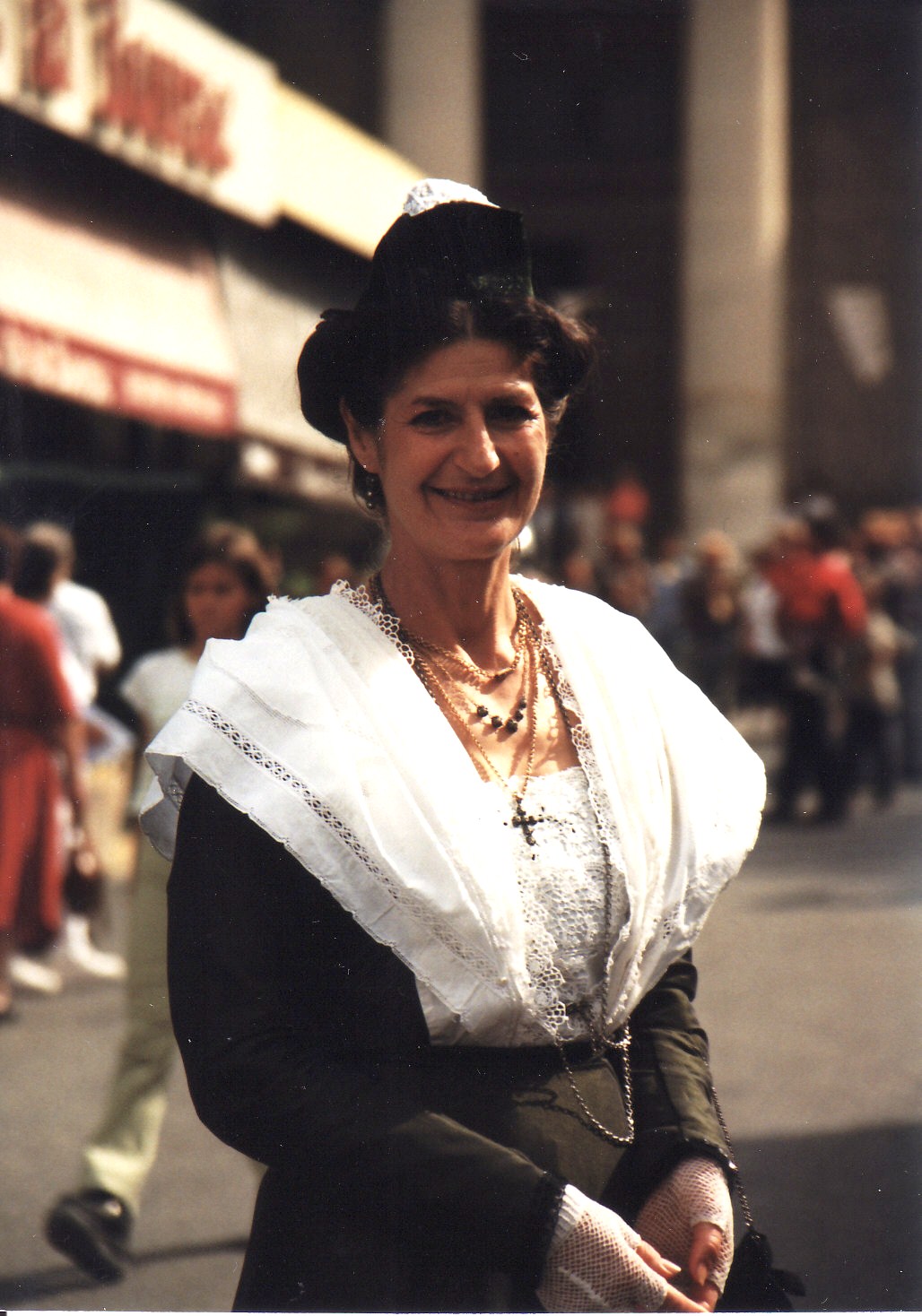
We had been to St. Remy on their regular market day. Vendor stalls of every kind radiated out from the town square into the side streets.  Everything from bras to bananas to baskets was available and attractively displayed: clothing, antiques, art work, jewelry, fabric, and flowers. There were foods of all kinds, enough to make a serious foodie weep for joy to see them, or for sorrow that so many of them are not available at home. A few days later that square was jammed with carnival rides and games. I don’t know how they wedged them all in there. We wandered around town, entertained by a strolling brass band. Everywhere we looked there were folks in Provençal costume, all very happy to pose for pictures. One lovely woman, dressed like van Gogh’s L’ Arlésienne, chatted with us and described the various parts of her costume. 

For lunch we went a bit south of town to Glanum, the site of an ancient Roman city. Their restaurant offers lunch as the Romans would have enjoyed it. The dish of the day was the Domitia Plate, four different things: a dish of mashed chick peas with olive oil, pepper, and cumin; roast pork with an absolutely delicious sauce of honey and - yes! - anchovies; duck pâté on toast; and melon chunks tossed with olive oil, cumin and coriander. I don’t think the Romans lacked for culinary delights if they ate a meal like that one.  

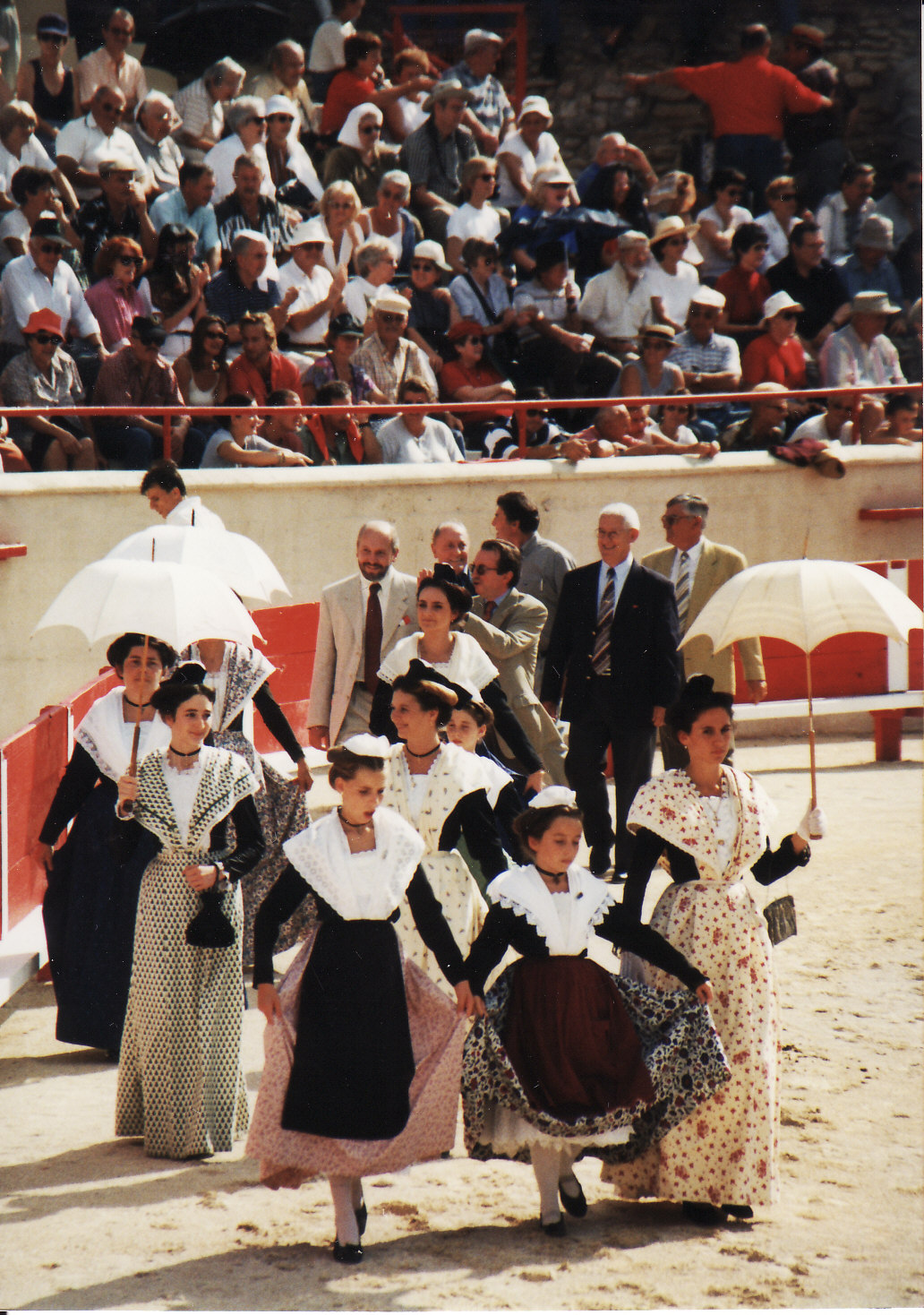
Lunch under our adjusted belts, we went back to the town arena to see the Camargue’s version of the bullfight. Much to our surprise, it turned out to be the grand re-opening of the arena, with all the local dignitaries on hand for some pomp and circumstance. The speeches and entertainment were accompanied by the same band, now in more elaborate uniforms. There was an amazing group of whip-wielding men performing a rhythmic, snapping, routine. We wondered how they kept their wrists in shape for such strenuous tricks. A few more speeches, and then, to our delight, in came all of the Gardians on horseback, performing a practiced quadrille, and the costumed folk we’d seen that morning. From little girls to elegant gentlemen and ladies, including L’Arlésienne, they did a measured promenade and a lively version of a May-pole dance.

Before ‘Inauguration’ we had located our ticketed seats and decided it was going to be a tight squeeze. Some folks had already spread out into our numbered spaces, so we hopped up and sat on the top wall where the view was unobstructed and perfect for taking pictures. Our move delighted some of the locals already sitting up there. They’d rarely seen tourists at such a local event. After the Inauguration the ‘Course’ began. Despite the language barrier - I’m only a bit conversant in French - they got over to us all about what would be happening.


This is a bull fight where the bull has all the advantages. The ‘fight’ is called la Course à la Cocarde, or the Course Camarguaise. Teams of agile men, dressed in white, vie for the cockades or knots tied to the bulls horns. The ‘raseteurs’, the ‘shavers’, wear a small rake-type device over their knuckles, and they dart in to meet a charging bull, trying to rake or snatch the knotted string from the bull’s horns. The team winning the most knots wins. 

The bulls are a small breed but their horns are wicked. They run the teams all over the arena. You can bet those men are extremely quick. Twice we saw a bull jump over the arena’s guard wall in pursuit of a raseteur.  Many times they chased men who had to jump up on the guard wall and then up onto the concrete wall of the stands in order to evade those horns.  But when the bull starts to tire, when he starts to foam at the mouth, he is quickly retired and a fresh bull enters the fray. Do the tired men get replaced? Mais non! Certainly not! At the end we couldn’t tell which team won and which lost, but it can be said, beyond a shadow of a doubt, that for several hours there was never a dull moment. 

Exhausted and elated, we headed back to our château home-away-from-home to celebrate our day with a bottle of good Rhone wine. À votre santé! 

Sunday, July 10, 2011

IT'S NICE TO BE NICE

We recently had a visit from a lovely nurse who is with the Homecare of Lancaster. She couldn’t believe that we were from New York. Evidently, in the course of her work here in several of our Sun City Carolina Lakes homes, she has run into some very unpleasant people from above the Mason-Dixon Line.  Not everyone from the north has given her a hard, rude time, and some from the south could also use a lesson or two in manners, but we surprised her by being so nice. SCCL people I ask you: what is with that?     

This woman, highly trained, supremely efficient and kindness itself, was in our home to help us - not the other way ’round. She has a lovely southern accent, as you would you expect from someone born and bred in Lancaster. She said she feels as though northerners view folks with southern accents as working with less than a full set of brains. But you know, to her, we are the ones with the accents. (Accents are funny things. Very often in the early hours of the day in the Lake House pool there are five of us with accents: one New Yorker, one Georgia Peach, one English-born, one German-born, and one Frenchman.  O.K., which one of us has the accent? And remember, two of those five speak more than one language. How many do you speak?) Accents tell others where we were born, not who we are and how much we know. That can be told by what we say and how we say it.           

I know that many of SCCL’s residents think nothing of giving a hard, rude time to the folks at the Lake House desk. The denizens of the desk say that a thick skin has to go along with the job, but that’s a sad commentary on how we live here. I can imagine myself manning the desk and spying some grim-looking resident coming up to face me. I’d think “Oh boy, here comes trouble.”  How much nicer it would be for me to greet a smiling resident with a sincere “How may I help you.”  If they said “I’ve got a big problem here and I need you to help me solve it,” their smile would already have put me on their side. Simple as that: it’s nice to be nice.

The stories told by the nurse or desk personnel are not unique. Many of our local merchants tell similar stories. In my humble opinion folks, this rude, ‘I’m better than you are’, ‘you are here to serve me’, ‘the world owes me a living’ attitude has got to stop. You are giving the rest of us a bad reputation. Ain’t none of us so wonderful, so rich, so absolutely right, or even so old, that we can be rude and thoughtless to others, no matter what their status, station or calling in life. 

Think of, truly digest, the words of the Golden Rule: Do unto others as you would have them do unto you.   Get beyond your pain or your problem, be pleasant if it kills you, and help will be given to you sooner and with a smile.  ‘As you would have them do unto you’ - fate forbid some folks should think to be as rude in return as some are to them. That would be nasty, and it might even come to fisticuffs. (Oooo, can I watch?)  

There are all sorts of mottoes and sayings that could be trotted out to tell you to have more regard for others - you probably know them all.  These two will suffice: ‘Remember the Golden Rule’, and ‘It’s Nice to be Nice’. Now - go to your mirror and practice your smile. 

Saturday, July 2, 2011

WHAT'S IN A NAME?

Today every Tom, Dick and Harry has a last name, but that wasn’t always so.  I doubt that our ancestors were named Fred and Barney, but until they started to sort themselves out and create a hierarchy, I’d surmise that everyone needed only one name.  For millennia, rural people were so far out of town that they knew everyone in the area.  It was when they congregated in cities that they had to tack identifiers on to their simple names.

Once folks realized there were others around with their name they began to tack on the name of town they were from.  Thus we have George Washington, whose forebears were from Washington in England, or James Galway, from Ireland. In English we don’t use the ‘from’, but among others, the German Von, the French or Spanish De, or the Italian Da, mean ‘from’. Think of Von Richtofen or DaVinci. 

Meanwhile, back at home, the population was growing.  Tom wasn’t the only Tom in town, so in many places he became Tom Johnson, the son of John.  In Arab countries a son was ibn-, in Hebrew he was ben-, they’re almost the same. In Gaelic, Mac or Mc means son, and O’ means grandson. Could a Scots-Irish lad be O’MacDonald?  In the Scandinavian countries a son was -son sometimes -sen. Erik the Red was Erik Thorvaldsson. A daughter was -dóttir or -datter. This is still used in Iceland, where Vigdís Finnbogadóttir was the world’s first democratically elected female head of state.

In other instances, instead of being a son of someone, folks added their profession to their given name. They became Tom Baker, Margaret Thatcher, Maurice Chevalier, or Robert Allen Zimmermann. One ‘n’ or two, a zimmermann is a carpenter, but we know this one as a singer: Bob Dylan. They might have had a characteristic that distinguished them: if they were redheads they might be Russo in Italy or Rousseau in France. If they lived by a lake or pond they became Veronica Lake or James Pond. If their father worked for a bishop, abbot, or priest, or if their father was one, they might use that as their surname.  Is that how that comic became Joey Bishop?  Nah, his last name was Gottlieb, which is German for God’s love, and that might have begun as a nick name.  

In 1979, the United Nations adopted a measure that states, among other things, that there should be equal rights in the transmission of family names. Parents can decide to give their children either the name of the father or mother, or a hyphenation of both – although no more than two names can be hyphenated. I wonder what happens when a Smith-Wong marries a Patel-Jones. Though in one form and one place or another this has been going on for a long time, many couples are now deciding on the wife keeping her own name and their children having a combined surname.  When James Pope marries Anne Sicola, their children’s surname will be Pope-Sicola.

So, surnames came from relationships, towns, locations, occupations, even nicknames. There are many whose origins remain a mystery. It’s said that the name Ryan can’t be traced, but that’s the luck o’ the Irish for you. Surname is from the Old French ‘sur’, meaning ‘super’ or ‘on’ or ‘on top of,’ and ‘nom’, meaning name. We’ve just skimmed the surface of surnames.  Names from our western European heritage, once so prevalent in the States, have been joined by a United Nations of names, and their origins are interesting and very intriguing.


Wednesday, June 29, 2011

ON BECOMING A CURMUDGEON


I don’t think I’m quite there yet, not quite ready to fill Andy Rooney’s shoes, but as I get older I feel more and more curmudgeonly. Some of the topics flying around SCCL lately just bring out the curmudgeon in me.

Wrong and Right
Have you ever heard this one: “Dogs are like string: every yo-yo wants one”?  We’ve got a few yo-yo’s around here, that’s for sure.  Most folks will say “oh, you don’t like dogs” or “you don’t understand”.  
Wrong: I like dogs. I’ve got four wonderful grand-dogs. I know something about the canine family, and I especially admire large, working dogs. (I do sometimes wonder at the sight of tall, hefty men out walking their miniature dogs. I want to yell “get a real dog” at them, but I suppose a little dog, however yappy they are, can be loved as much and mean as much as a large one.)   
We had several dogs when I was growing up. One memorable dog was a juvenile Great Dane that my uncle brought to us when we first moved to the countrified wilds of Nassau County, Long Island, from the civilized, citified sanity of Queens, New York. He thought we needed a dog for protection. After a week or two, my Mother decided she’d risk life and limb and the security of the family, rather than to have to feed that dog. I learned about the economic impact of dogs, and pets in general, at an early age. I love dogs - just for other people. I do not want to have to spend retirement funds to feed them, vet them, kennel them when we travel, or walk them on a schedule that’s theirs, not mine, much less scoop their poop. Other people are welcome to do it, just not me. But I do like dogs. 

Right: I don’t understand. Here’s where the ‘yo-yo’ comes in: I don’t understand some of the dog owners here at Sun City Carolina Lakes who have so little respect for their fellow homeowners that they don’t curb their dogs and/or don’t clean up after them. They’d have a fit if another dog walker left a load on their property.
I could not believe it when we were told of folks who dump their doo-bags (to be distinguished from doo-rags) down the drainage grates in our streets. For Pete’s sake, the drainage grates are not sewers. The water ends up in our own little Carolina Lakes.
And another thing: I don’t understand the people who think the SCCL HOA is there to provide their personal supply of doo-bags. (I also don’t understand why the HOA pays for these bags in the first place. A nice little addition among many other deletions?) The HOA puts the bags out and they disappear before you can say scoopy-doo. How cheap can these folks get? I realize that some people are just built this way, but I wish they weren’t. Well – I could go on, but…

This is just one of the things that regularly strike me as being fodder for a good grump session. I find that with age I haven’t gained more wisdom: I’m just viewing things with a more cynical eye, with a little more skepticism, and with a lot more disbelief. I read or see something that strikes an off-key note, and it all sets me grumbling and complaining. I hope to be writing more about such things. It will take a while more for me to become a full blown curmudgeon, but I’m working on it - it’s such fun.

Sunday, June 26, 2011

TO SLEEP, PERCHANCE TO DREAM...


...ay, there’s the rub – the rub for us seniors, that is.   Very rarely can we say we slept like a baby because we usually sleep like a senior.   We have a hard time getting to sleep and staying asleep.

Some studies say that a third of Americans don’t get enough sleep, others say it’s about 49%. Wherever you look they’re throwing numbers at the problem.  We all know that good sleep is essential to our health and well-being and that our ability to sleep changes as we age.  Health problems can plague us and keep us awake at night. They say that you should establish regular, calming routines to lull yourself to sleep.  I say “Nonsense! It’s time to shake it up, not wake it up.”

You may be able to think up your own routine-shaking changes; meanwhile here are some you may want to try.  As someone’s Mama might have said: “It couldn’t hurt.”

Don’t You Worry ‘Bout a Thing
Flush your worries before you turn off the bathroom light or they’ll come in to bed with you. Don’t worry about the kids and grandkids. Lying awake to worry on their behalf won’t make any difference in the long run.  Try not to think about health problems: worrying about them isn’t an accepted medical treatment. Don’t make any major decisions while you’re trying to get to sleep.  Make decisions just after waking up when your brain is fresh.

The mind’s eye is a useful tool.  Don’t just lie there: think of something. Try reading an interesting article before bedtime.  Read a bit from magazines like Smithsonian, National Geographic, Popular Mechanics, or whatever publication caters to your interests. Think about any recent book you’ve read or movie you’ve seen: what happened after The End?  Revisit great places you’ve been or rerun great times you’ve had with family or friends.  Start the plot outline for a book you could write. (You might want to keep a pad and lighted pen on your night stand.) As you prepare for bed be planning the topic for your train of thought – let the train take you away into sleep.

Don’t Knock it if You Haven’t Tried It
Eat two slices of bread before bed – before you brush your teeth, of course.  Just bread, no butter or jam, but maybe a teaspoon or two of honey which is said to be a sleeping aid.

Sleep in the buff.  Nightgowns and PJ’s can be constricting and lumpy, and you have to fight with them when you turn over, and you get aggravated and…!  Try a night without them.

Keep cool. Turn down the thermostat at night in the warm weather.  Which comes first: your sleep and your health or the electric bill?  Keep cool in winter too.

Move the alarm clock.  Turn its face away from you so that you don’t watch the clock and agonize over all the time you think you’ve been awake.  Ignorance is bliss.

Get rid of your old-faithful easy chair.  If you’re one of those who fall asleep in front of the TV in your comfy chair you're robbing yourself of proper sleep in bed.  Rearrange your living room if you have to.  If TV bores you to sleep why watch it?  If you’re falling asleep go to bed.  You might want to change your regular bedtime to an earlier hour.  

When I was little I usually had to take a nap, especially if were doing something special that night. My Mother always told me that I didn’t have to sleep but did have to rest.  Nine times out of ten I’d fall right to sleep.  Don’t worry about sleeping – get it off your mind: just rest.  Try some of the sleep routine-shaking changes above.  They might just work for you.


Monday, June 20, 2011

DO YOU KNOW ROY G. BIV?


Do you know Roy G. Biv? You might remember him from high school General Science class. He’s the mnemonic we learned in order to remember the colors of the rainbow: Red, Orange, Yellow, Green, Blue, Indigo, and Violet. “My heart leaps up when I behold a rainbow in the sky”, said Wordsworth – so says everyone, of course.  We all thrill watch of that awesome sight.  We all love colors. In these days of digital photography, high definition TV, and the internet, color almost explodes around us. It has become very important in our homes, gardens, and workplaces.  

Color is very significant to all of us, and we react intuitively to it. In western culture there is almost universal agreement on certain colors evoking specific states of mind. Red is, of course rage – we “see red”, and it is associated with blood and sin: The Scarlet Letter comes to mind. Someone is said to be “green with envy” or “yellow bellied” – not very nice associations. A whole school of music is devoted to the Blues. Have you ever heard of someone being in a “brown study”? He’s in deep thought or even daydreaming.

Then there is the ominous “black as death.” Curiously though, where westerners choose black as the color of mourning, white is the color chosen in the Orient. Easterners intuitive sense and use of colors is usually quite different than those of the west. Purple is the color of royalty in the west, yellow in the east.  Europeans don’t use colors to represent the directions, but the south, just one of the four directions, is seen as yellow by the Maya, red by the Chinese, and white by Native Americans. 

Science doesn’t know when we first gained it, or even when we lost it, but some say we still have the ability to see auras in other people. The colors seen as auras differ in meaning from both the eastern and western associations, with the exception of the colors gold and pink.  A golden yellow aura or halo, seen in paintings and icons and other depictions of holy people, signifies spiritual achievement, joy, and even a great intellectual ability.  Pink is pink everywhere you go: a happy, balanced state of being, being “in the pink.”  

SHOW YOUR COLORS 
Throughout history, in so many different ways, it became important to “show your colors”. From times when very few if any of the people were literate, various color systems, used along with significant symbols, were devised to let them know who was who and what was what.  It is so interesting a subject that the theory and study of how cultures communicate with color, signs, and symbols has developed into a formal field of academic study. Heraldry and symbolism told a tale. Colors and crests, plaids and patterns distinguished one side from the other in combat. Today’s street gangs know the importance of colors. Liturgical colors used on vestments reminded the people of the upcoming events to be celebrated.  Standard symbols on great stained glass windows told stories to people who couldn’t read.  

Say “show your colors” to an American and they’ll think of red, white and blue.  Is it any wonder that we are partial to flags showing these same colors? Think of the flags of England, France, Norway, or Holland. I really like the flag of Nepal – it’s red, white, and blue, but it isn’t flag shape.  And how ‘bout that Lone Star flag of Texas? The designers of the Olympic flag diplomatically joined five rings, symbols of unity, one for each continent, and colored blue, yellow, black, green, and red.  At least one of those colors appears on every national flag.      

My earliest, favorite, happiest association with color, and perhaps yours too, was with a box of crayons – Crayola, naturally.  Just the smell of a box of crayons today brings back all sorts of memories, especially the times when my first grade teacher chose me to help give out the crayons for art period. I am still the proud owner of my own 48 count box of Crayolas. I say “my own” because I keep another, well used box of crayons for my grandchildren.  Heaven forbid they touch my box! 


Monday, June 6, 2011

AUDUBON

This is the original of an article edited and posted in Living @ Sun City Carolina Lakes. Audubon's is a name we all recogize, but most of us know little about his life. I'm pleased that I was asked to write the article.
The first picture is mine - not Audubon's, of course.


When she was born in 1970, my goddaughter’s grandparents gave her a lifetime membership in the Audubon Society.  Along with the membership came a beautiful, large Audubon print – not one of the originals, of course, but a good one never the less.  It was probably the first time I saw an Audubon print, and I’ve admired them ever since. 

There is something very appealing about the way Audubon depicted the birds, and later the animals, of North America.  Previously, it was the custom of naturalist painters, who dismissed his work as inferior, to depict the subject animal with very little to distract from its pure presentation. They were as lifeless as stuffed specimens in a museum drawer.  Audubon enlivened his pictures by including the subjects and their natural habitat as well. Not just siting subjects, but subjects in motion:  Peregrine Falcons tearing into a goose with feathers flying, or a Louisiana Heron preening its feathers.  They became pictures to collect, pictures to study, pictures to enhance a home.         

John James Audubon was born in what is now Haiti in 1785, and was raised in France.  He was evidently an accomplished, handsome young man, riding, dancing, and playing the violin.  He was interested in his natural surroundings, especially the birds, and began drawing what he saw and collected. Sent to America when he was eighteen to oversee one of his father’s interests, he lived the life of a woodsman and naturalist as well as that of a businessman. Over the years he continued collecting and recording his findings, traveling widely through the north-eastern and middle-eastern states. He was the first person in North America to band birds.  He tied yarn to the legs of Eastern Phoebes to see if they returned to their nests each year.

Though sometimes very successful in business, his own ventures finally failed when he was in his early thirties.  He developed an idea he’d had for a while, and began to work on what would become The Birds of America. He traveled through territory new to him, particularly Alabama, Florida and Mississippi, recording the birds and habitats there.   As he began to do the drawings and paintings, attempting to complete one subject a day, he had to hire hunters to collect specimens for him.  At one point he learned a new painting technique and redid all his previous work.  Along the way he discovered twenty-five new species and 12 sub species, and recorded for us some birds, such as the Carolina Parakeet and the Passenger Pigeon, that are now extinct.

After having the work rejected here, on good advice he took it to England in 1826. It was an immediate success.  The English took to anything relating to wild America. By subscription, lectures, and other means, he raised enough money to begin publishing the series.  Though later issues would be printed on smaller paper, the originals were printed on paper about 29 by 40 inches, showing all the birds life size.  Around 200 sets of 435 plates each were produced until the last print came out in 1838.  Printing the plates and having them hand-colored was extremely expensive. The prints were sent out, five plates at a time, unbound and without text to avoid having to furnish free sets to the public libraries in England. The text, Ornithological Biography, was published separately in Scotland in five volumes, the last of which came out in 1839.


In December of 2010, Sotheby’s sold a complete set of The Birds of America for a record $11.5 million, including the commission.  I know Audubon could have used a piece of that pie.