Friday, September 30, 2011

CURIOUSER AND CURIOUSER


Since I started this blog I often check the lists of holidays, anniversaries and observances for new topics to interest my readers.  In my search for the new and unusual, October comes up trumps. Of all the months of the year, it has the longest list of celebrations.  They range from the sublime and the expected, such as Columbus Day and Halloween, to the ridiculous and really unusual like Babbling Day and National Mole Day.  This last one isn’t about moles on your chin or under your lawn, but is an effort, they say, to increase interest in chemistry by celebrating Avogadro’s number, 6.022141527 × 10²³: the mole. An unusual holiday, an unusual number, but has it increased your interest in chemistry? No, I thought not.

The holiday that first got my attention was Mad Hatter Day, which Carnegie Melon University’s website says is to be celebrated on October 6. It’s is an attempt to give the year a second day of silliness, six months later than April Fools’ Day. Why the sixth of October and not the first? Because in Alice in Wonderland, the Hatter has in his huge top hat’s band a label that says “in this Style 10/6” Ten shillings, sixpence.  Someone clever noticed the convoluted connection of dates and madness and took off with it. 

Foodie celebrations are rife this month: angel food cake, apple jack, bologna, brandied fruit, candy corn, cookies, country ham, eggs, frappes, mincemeat (you’d think that would be in December), nuts, pasta, pickled peppers,  pizza (isn’t that every month?), popcorn, pork, pretzels, pumpkin cheesecake, seafood, spinach, and, not in alphabetical order, eew! Moldy Cheese Day. Yes, of course bleu cheese and others are moldy cheeses, but mold, like mole, has unpleasant associations. Added fun for foodies can be found on World Vegetarian Day, the end of Oktoberfest, Cookbook Launch Day and National Dessert Day. 

How ‘bout Babbling Day?  On October 21, it is the day for endless conversation, not a day to be quiet.  There’s little to be found about the origin of this celebration, but it’s sure to be loved by teenagers with cell phones. 

Under the heading “Why Would They?” can be found days like Bald and Free Day, Moment of Frustration Day, International Skeptics Day (are you sure?), Wear Something Gaudy Day, Count Your Buttons Day, and Punk for a Day Day. You can bet your buttons that the guys in this picture are Punks for more than a day. Those are coiffeurs to make the “Saturday at the Salon” set envious. Those hairdos take time and work, and a definite loss of sleeping comfort.

Under the heading “That’s a Nice Idea”, we’ve got International Frugal Fun Day, Sweetest Day, Smile Day, Dictionary Day, Mother-in-Law Day, Family History Day (get the details from your Mother-in-Law), and Make a Difference Day.  In October we celebrate custodial workers, teachers, physicians’ assistants, TV talk show hosts, and the clergy.
There are many observances to make us aware of conditions like depressions, Down’s syndrome, and spina bifida. If you are of Filipino, Italian, German or Polish descent you don’t have to wait for Halloween to have a party.  Just be sure to serve some of the foods on the October list.

There are celebrations and observances for every day, every week, and for the whole month of October – many more than could be included in this piece, which has become something akin to a shopping list.  Some of these should be shared with December and July, the months with the fewest observances.  If I’ve mentioned any holidays that appeal to you I’m sure there’s an ecard you can send for the occasion. 
                               

Monday, September 19, 2011

1066 AND ALL THAT LANGUAGE **

There are two reasons to celebrate September 28th this year. It’s the 37th anniversary of my wedding. (No gifts, checks to your favorite charity will do!) It is also the 945th anniversary of the arrival in England of William II of Normandy, known to us all, after the ensuing Battle of Hastings, as William the Conqueror. 

My wedding has had little or no effect on the great state of things in general, but the Norman Conquest had an extremely pronounced effect on all of us reading this article. Within a few hundred years of the battle, thanks to the French, the language spoken in England went from being mostly Germanic to one with a heavy mixture of the Romance or Latin languages. The Romans did invade the island in 55 BC, and more or less messed about there for about 450 years, but at that time they left little of their language behind. The subsequent invasions by all sorts of Germanic tribes saw to today’s English being classified as a Germanic language. The Latin of the Romans, along with a lot of Greek, came back to England via the Normans.

Language is fascinating to me. A representative map of just the major languages would have the colors of a small box of crayons. A map of all the languages of the world would have more colors than the paint chip racks at the local hardware store. I wish I knew more than English and a soupçon of French. In my European travels I’ve been able to get along with spoken and written language because of the similarities to the English words. I remember seeing the sign ‘Apotekit’ in Oslo - of course: apothecary – a drug store. I was pleased with myself for that one. I was also humbled when I learned that I was entirely off base with my assumption* that few Norwegians would speak English.  Four of us were standing on a street corner in Stavanger, going through the Norsk:Engelsk dictionary, looking for the translation of ‘battery’ because our Brit friend had forgotten to bring some for his hearing aid.  A Norwegian gentleman tapped one of us on the shoulder and quietly enlightened us: “Don’t worry, they speak English in the shop.” Too true. The study of foreign languages, especially English, French and German, is compulsory in Norway and many other European countries.  

When someone apologizes to me because of their poor English, I always apologize in turn.  After all, they speak my language, but I don’t speak theirs. The world seems to be using more and more English. It has become the default language for air and sea traffic. Though the Chinese are catching up - after all, they do have it over us in population - the highest percentage of internet users speak English. While the teaching of other languages in our schools may be declining, our own language is quickly absorbing new words from all over the world. It’s not the same old Germanic/Latin base it once was. Pity the poor editors of the Oxford English Dictionary - 22,000 pages or so, and increasing every day. From pajamas and khaki, safari and coffee, to gung-ho and feng shui, and origami and karaoke, our language just gets bigger and better.


* Of course you know what ‘assume’ does - it makes an ‘ass’ out of ‘u’ and ‘me‘


** September 26th - by coincidence, this came up today on Garrison Keillor's "The Writer's Almanac": Today is the official European Day of Languages, which is a yearly event begun in 2001 to celebrate human language, encourage language learning, and bring attention to the importance of being multilingual in a polyglot world. On this day, everyone, young or old, is encouraged to take up a language or take special pride in his or her existing language skills.

There are about 225 indigenous languages in Europe, which may sound like a lot but is only 3 percent of the world's total. Children's events, television and radio programs, languages classes and conferences are organized across Europe. In past years, schoolchildren in Croatia created European flags and wrote "Hello" and "I love you" in dozens of tongues while older students sang "Brother John" in German, English, and French. At a German university, a diverse group of volunteer tutors held a 90-minute crash course in half a dozen languages, like a kind of native-tongue speed-dating, groups of participants spending just 15 minutes immersed in each dialect until the room was filled with Hungarian introductions, French Christmas songs, and discussions of Italian football scores.


Saturday, September 10, 2011

A CURMUDGEONLY OBSERVATION

‘fI Were King of the Forest…
    …well, I’d never be king of the forest, but ‘fI had some more influence than I do, I’d take the Sun City Carolina Lakes HOA Board to task for not allowing solar panels within the community, South Carolina law not yet requiring they be allowed notwithstanding. This is from the latest HOA Board of Directors meeting (unapproved) minutes:  Discussion was held on whether to allow solar panels within the community if a request should be submitted through the modification committee.  The Design Guidelines deny the panels and there is no legislation within SC that required approval of solar panels at this time.  A motion was made and seconded and voted unanimously not to change the Design Guidelines in regards to solar panels.

Of course, I was not privy to the entire discussion or the thinking behind it, but I can guess that the main reason was that the solar panels might not look too elegant on the community roofs, and prospective buyers might think them a detriment to the area. (There’s no accounting for that kind of thinking, but it does exist.) Fate forfend that SCCL should look at all environmentally friendly. The board being composed of Pulte employees, their vision and version carry the day for now.
I must acknowledge that the Design Guidelines do allow for ground mounted solar panels in the "Private Area", but this option is difficult where sunward position of the house or the small size of the yard would prohibit installation. You could put panels on your patio if is gets the sun, but you'd have little room left out there.

Never mind the meek: the smart will inherit the earth, the boy- and girl-scout types will inherit the earth.  Come the day that a major solar flare aimed right at the earth knocks out all our mod cons, those with a bit of forethought will come out smiling.  Unless the power powers-that-be can detect the flare early enough to shut down world systems, the grids will fry.  Envied will be those who’ve got backup on water and food, or who’ve got suitcase-size solar chargers for their cell phones, iPods, PC’s, batteries, and radios – that is if there’s a worldwide web or a phone system working.  The man who has a generator and the gas to run it will be the man to know.  Were solar panels allowed here at SCCL, the house with them on the roof would be the place to go.  I’m not holding my breath on that one.   
 

Friday, September 9, 2011

IT AIN'T OVER 'TIL THE FAT LADY SINGS...

  ...not this fat lady, but read on about    A NIGHT AT THE OPERA 
             
No, we’re not talking Marx Brothers, we’re talking Puccini, Verdi, Bizet, Wagner – well, not too much Wagner, that’s a bit heavy.  We don’t usually go ‘round humming a tune from Tannhäuser, although the second act is a singing contest.    I remember long-ago Saturday afternoons, listening to Milton Cross present the live broadcast of that day’s production of the Metropolitan Opera.  I think I liked his voice as well as those of the singers.  This month marks the opening of the new season at the Metropolitan Opera. Wouldn’t it be lovely to be there?

Did you know that over these last decades many of our favorite popular tunes have been politely borrowed from the world of opera?   And many of opera’s popular tunes were originally borrowed from what were then popular tunes.  The music goes round and round.

For years, British Airways has used the music of the “Flower Song” from Delibes’s “Lakmé” as their theme. Nissan’s uses the “Ride of the Valkyries” from “Die Walküre”, yes, by Wagner.  The music for “Stranger in Paradise” and other songs in “Kismet” came from Borodin’s opera “Prince Igor”. For Jackie Wilson’s “Night” the music came from Saint-Saëns’s “Samson and Delilah”. Don’t be put off by some of the long titles of opera pieces: they’re usually just the first few words of the song.  That piece from “Samson and Delilah” is titled “Mon coeur s’ouvre à ta voix,” and means “My heart opens at your voice.” You needn’t remember the title – just appreciate the music. There are many more examples, but then this article would be a list of songs, not an appreciation of opera.

My husband doesn’t want to sit through or even hear an entire opera, but his favorite listening is collections of popular opera favorites. He's worn out the LP of Pavarotti's Greatest Hits, and we were lucky to replace it with a CD.  I love the opera, and can sit through one just to hear the music and watch the production, the same as with a Broadway show. 

“Porgy and Bess” is the best of both. I must admit that I’m happier seeing a show because the dialogue is spoken. Dialog is usually sung in opera, and it’s generally in a language I don’t understand. It helps to know the story line. Though they can be distracting, today there are subtitles on TV opera airings, and surtitles running on a box over the stage for the theater-goers.  At the Met they even offer “Met Titles”, electronic devices mounted on the seat in front to show you the translations. 


Though there are several comic operas, most operas are dramas and their music can be very moving.  The opera “Norma”, for example, is no “My Fair Lady”. Norma has a secret lover by whom she has two children that, in her despair, she is about to kill. What with one thing and another, Norma dies with her lover on a flaming pyre. I’ve never seen that staged. Not too light, is it? Yet one piece from it, “Casta diva,” was one of the most popular tunes of its day

One of our neighbors doesn’t like all those screaming ladies in the opera, and I can’t blame him much. Out of context and just heard in snatches, it can be quite unappealing. Today, many opera newbies would consider “Casta diva” a screamer, and I’d think them right if I didn’t appreciate the power in a voice like that of Maria Callas.  Hearing a recording of her singing that aria, or “Suicidio” from “La Gioconda”, will either give you chills or send you, screaming yourself, right out of the building. 

Larger-than-life characters with wonderful voices, like that of Callas, sustained opera. In recent decades, singers like Luciano Pavarotti helped to popularize it.  He was about as colorful and large a character as was ever seen in the world of opera. Thanks to him and others like Plácido Domingo, or Beverly Sills, who brought acting to opera, there is a wider audience today. New listeners have come to appreciate the great range of opera music from light, lyrical pieces like “The Bell Song” from “Lakmé”, one of my favorites, to beautiful duets and stirring pieces like the “Anvil Chorus” from “Il Trovatore”. 


From other disciplines, people like movie producer and director Franco Zeffirelli have brought modern staging, design, and costuming to update many of the classic operas. Opera, once found outside of the great cities only on the radio, has blossomed in productions all over the country.  It’s regularly offered on television and it can be seen live, in HD, in hundreds of movie theaters.  Near us, a series of eleven works, live from the Metropolitan Opera, will be shown in Charlotte at the Stonecrest 22 at Piper Glen. You can check it all on line at metoperafamily.org. 

Try it, you might just like it.


-

Friday, August 26, 2011

A THOUGHT FOR THE DAY

Andy Warhol's version of our Birthday Boy

Ah, yes, August 28th. Can’t you just hear the cheers? Can’t you just see the fireworks?  You are, of course, very aware of whose birthday we celebrate today, aren’t you?  You really don’t know?  Why it’s Johann Wolfgang von Goethe!  I’m sure you just forgot that momentarily.  Goethe, we rarely use his full name, born in 1749, was what they call a polymath.  He wrote works in drama, poetry, literature, science, theology, and philosophy. This guy was interested in everything at a time when, such as it was with da Vinci, it was still possible to know a lot about a lot of things. Not too many of us can go through life without hearing a reference to Goethe’s most famous work: Faust.

What I want to bring to your notice is a line of his, a thought for the day that can be of use to us all: “One ought, every day at least, to hear a little song, read a good poem, see a fine picture, and if it were possible, to speak a few reasonable words.” I keep a small collection of ‘pithy’ sayings, and that one is one of the best. Written in the eighteenth century, it can easily be interpreted for today’s mode of living. I don’t interpret it for today to mean that you have to do all those things, but do break out of your quotidian routine to do something inspiring, or educational (look up ‘quotidian’), charitable, or just plain fun.  

Part of my own quotidian routine is to check several of my favorite websites for thoughts or poems of the day. I do prefer rhyming poems over free verse, some of which read more like a novel than a poem. Thoughts, especially when you catch them at an early hour, can get right into the flavor of your day.  From ‘Anonymous’ to named sources, from ancient times to modern, valuable thoughts abound.  Here are some of my favorites:

“The wise man achieves balance by reducing his needs to the level of his possessions.” Anonymous (but sometimes attributed to Aristotle)

“Have nothing in your house that you do not know to be useful or believe to be beautiful.”  William Morris

“A common mistake that people make when trying to design something completely foolproof is to underestimate the ingenuity of complete fools.”   Douglas Adams

“A people that values its privileges above its principles soon loses both.”   Dwight D. Eisenhower

“Don’t believe everything you think.”   Anonymous

“Do not be too moral.  You may cheat yourself of much of life.  Be not simply good; be good for something.”   Henry David Thoreau

“The time you enjoy wasting is not wasted time.”   Bertrand Russell

“When people show you who they are, believe them.”   Maya Angelou

“Function in disaster, finish in style.”   Lucy Madeira


E. B. White said: “I arise in the morning torn between a desire to improve the world and a desire to enjoy the world. This makes it hard to plan the day.” Get your daily fix, a daily thought, and try to do both: improve and enjoy the world.   

Friday, August 19, 2011

THE FIVE AND TEN CENT STORE


When I was a kid my Mom gave me a small allowance. The kicker was that I couldn’t spend it all and had to give her back a certain amount of it at the end of the week or she’d deduct that from my next allowance, and I’d still have to save the same amount for the following week.  It made a fairly wise spender out of me, I can tell you that!  I can also tell you that, unknown to me, she banked those savings.  One day she handed me a small, brown savings passbook (I can still remember the color) with a tidy amount in it.  I’m not sure why I got the passbook when I did; the occasion has been superseded in my memory by the fact that I had undreamed-of savings in my hands. I do remember wanting to have some of it to take to the five and ten.
The Spalding Pinky
I loved the five and ten cent store.  I wasn’t given any treats there like the slice of bologna from the butcher or the cookie from the baker, but the treat was in all the different stuff to be seen there – everything from candy to cake pans, with great things in between.  Pinky balls, roller skates (and skate keys – I lost mine several times!), hankies, underwear, crepe paper, kitchen utensils, school supplies, or cosmetics – today we have specialty stores for most of this stuff, but then you could get it all at the five and ten – F.W. Woolworth’s to be sure. 


There was no one smell in the store – nothing like going into the bakery or drug store – but many smells: toiletries and soaps, rubber toys, pop corn, and the aromas wafting from the lunch counter.  We never had anything to eat at the lunch counter, though I wanted to.  I’d have liked to sit on one of those swivel stools and go round and round.  But in those times Mom was really watching the budget so we ate at home.

We moved a few times during my childhood, and I recall the ‘early’ five and tens, but the last was the most fun.  As with most stores of that day, the floor was wood.  It had buckled down one aisle, and it was fun to try to walk the whole way on the hump, or walk with one foot on each side of it – sort of like walking along a street with one foot on a curb and one in the gutter.

Many things we got at the five and ten are scarce today, and going to a dollar store (I call a lot of that stuff junk) or Walmart is just not the same. I will say that the closest match to the five and ten experience is going to the Vermont Country Store up in Weston, Vermont.  They bill themselves as being "purveyors of practical and hard-to-find products." They’ve got all sorts of things I haven’t seen in years: Glass Wax, Tangee lipstick (the first lipstick I was allowed to use), hair nets, Garibaldi biscuits, and lots of penny candy. They’ve even got the bumpy wood floors.

Today the Vermont Country Store
 stocks many of the same items that
were available at this Woolworth's
Before we moved to SCCL we lived only about an hour away from Weston, so a trip up there was one of our usual jaunts.  If you’re ever up that way you should make it a point to visit the Vermont Country Store and some of the other nice shops in the town.  And you can have a great lunch there too.  The Ortons, owners of the Vermont Country Store, have made the house next door into the Bryant House Restaurant.  Try the ham and cheddar melt or my favorite, the Monte Cristo, and an apricot sour.  The lunch counter at Woolworth’s was never like this – some things get better, I’m delighted to say.


Wednesday, August 10, 2011

A MATERIAL THING

National Sewing Month is September, but every month was sewing month at my house when I was growing up. My mother sewed for us and for the house, and her sewing machine was rarely idle.


From play clothes to wedding gowns, my mother could whip up something from the oddest things. My sister and I once had skirts made of kitchen curtain fabric. The flowered-border ones were all right, but my favorite was an all over chicken-wire print with hens and chicks running around the bottom. Many of our costumes came from whatever was at hand, but some of the most colorful ones were sewn from crepe paper. You don’t see too much of that these days. In my mind's eye I can see a big display of crepe paper at the 5 & 10 cent store. Ah, the 5 & 10's - remember those?


This picture from the net reminds me of
my Mom's machine.


I distinctly remember, although it must be over sixty years ago, when my mother disappeared into her bedroom each evening after supper. We didn’t know we were getting new Madam Alexander dolls for Christmas, and my mother was working on wardrobes for them. Most of the outfits were miniatures of what she had sewn for us, sewn from the leftover material. She made dresses and pajamas and plastic rain coats. She crocheted sweaters and hats and shoes. She swore she’d never tackle such a job again! 


This pix is from almost 50 years ago.  Alas, the
 train isn't spread out for you to see

I think her masterpiece was my sister’s wedding gown. At that time both my mother and sister were working at Columbia Ribbon & Carbon in Glen Cove, New York. One of the items they manufactured was typewriter ribbons. Ribbon silk came to the factory as 14 inch-wide fabric. It was inked and then slit into the correct size and wound on to the spools.  The creamy white silk was lovely, and my Mother was given enough to make both my sister’s gown and my maid-of-honor dress. Mom joined the panels with wide lace for my sister’s gown, gradually increasing the length of the back panels until they formed a small, graceful train. She joined the panels on my dress with narrow, pink-embroidered tape. I still have some of that tape, and I cherish it.


The Christening outfit I made in 1989

 
My mother taught me how to knit and my sister how to crochet. I don’t know why, but neither of us learned the other craft. My sister always crocheted ‘backwards’ because, as a leftie, she mirrored what my right-handed mother was doing. My sister and I continued on sewing in our mother’s tradition making everything from curtains to Halloween costumes.

My hands are quite stiff and arthritic these last few years, so I rarely sew any more. A bit of mending, or perhaps whipping up a new pillow cover or two, is about all I’ll do. My last big job was the drapes for our new house here at SCCL. They’re not as fancy as some I’ve made over the years, but I’m pleased with them. The most tedious thing I ever made was a pair of 18 foot-long drapes for my daughter-in-law’s two-story living room. Yards and yards of fabric and lining. I thought that job would never end, but the curtains and drapes for her new house were a labor of love. 

What I consider my own masterpiece, another labor of love, was the Christening outfit for my first grandchild. I was doing the embroidery on it even as she was being born over twenty years ago. There is a dress, a slip, a coat and a hat - and not an uncovered or raw seam in the whole set. After each child wore it I embroidered their name and birth date on the dress. Now the outfit has been worn by my first great-grandchild, and the tradition continues.


Saturday, August 6, 2011

THE MIND'S NOSE


In my mind’s eye I’m young – thirty something – until I look in my mirror.  But my mind’s nose knows no age - it looks in my memory, not in my mirror. Nostalgia comes in many forms. I’ll hear a tune from the Sixties and I’m swept back many decades, perhaps to the place when I first heard that tune   I’ll go through one of my many picture albums and start remembering when – and wishing I was there. A stray memory can bring up an aroma; a stray aroma can also bring back memories

I made whole-wheat multi-grain bread today.  The aroma in the house is just wonderful.  It reminds me of going with my Mom to the local bakery when I was a kid.  You’ve heard of ‘comfort food’, how ‘bout ‘comfort smells’? I love the cinnamon of apple pie or coffee cake, the tang of spaghetti sauce (easy on the garlic!), beefy charcoal-broiled burgers, and Thanksgiving turkey.  What’s on your comfort smell list? I’m betting it will have a lot to do with cooking.

I remember the delicious aromas - hot dogs, corn-on-the-cob, and cotton candy - from Coney Island, and the smell of getting there on the subway.  When we lived near Albany, New York, my husband and I went to the New York State Museum in the opening weeks of the New York City exhibit.  I hadn’t been on the subway in years, but stepping into that old A-Train car brought back the memory of so many subway rides.  I was delighted that the car still had that unique, perhaps electrical, smell.   Several years later when we took visitors to the exhibit the smell had been washed away – I suppose from the building’s air conditioning.  What a disappointment!  I may never again get to sniff that smell first hand, yet the smell is in my head, filed away in its proper cubby hole.

Do you remember the smell of an old-time drug store?  In my adult years I found out that it was from B-vitamins.  And now I know the smell in the dentist’s office was cloves – oil of cloves was used as an antiseptic and a tooth pain reliever. I’ve got the smell of school tucked away in my memory, lots of chalk dust in the air, and the smell of Crayola crayons carries me back over sixty years.  I’ve got Channel No.5 tucked away too: that was my Mother’s perfume.  

Many candle and household products companies have made a bundle on the smell of clean laundry, among other comfort scents.  I remember my Mom bringing in the laundry on a freezing day.  The sheets and clothes would be stiff from the cold, and the smell would be of fresh, fresh air.

There are ‘today’ smells of which I’m not particularly fond: gasoline, tire rubber, Bowater paper mill in the early morning, the smell of the fitness center at the Lake House. Even the smell of the chlorine in the pool makes my nose wrinkle when I first walk in.  There are some nasty smells we all recognize, and perhaps they’ve got memories associated with them, but I don’t need to dwell on them here.  No – I’ll close this trip down my olfactory memory lane with a suggestion for your own trip: go shake out and sniff some baby powder.  I’m sure your mind’s nose will bring up some lovely memories.

The candle companies can reproduce some wonderful aromas for the mind's nose


Monday, July 25, 2011

A (very) SHORT GUSTATORY TOUR OF ITALY...

...in honor of Lasagna Awareness Month

Funivia from Rapallo to Montallegtro
July is Lasagna Awareness Month? Are they serious? Why should we be ‘aware’ of lasagna? Isn’t everyone? Just who came up with this? The cheese industry? The pasta industry? The tomato industry? No, not the Italians. They’d celebrate all food and wine, not just one tasty dish. Who would own up to wanting to celebrate this in July: this is a dish for the cooler weather. I never had lasagna in Italy, but all this food talk reminds me of what I did have.

I have to admit that I’m partial to Italian food. You will appreciate, of course, that the best pizza I ever had was in Italy: a wonderful Margherita pizza we enjoyed at lunch in the Piazza della Signoria in Florence. Or was it at that restaurant in Rapallo? So many pizzas, so little time.

The best way to experience any country is to go with a native. We had this luck in Liguria. Liliana, a colleague of our former daughter-in-law, took us on a gustatory tour. In Chiavari we enjoyed farinata, a pizza made with chick-pea flour. Further west on the French Riviera this is called socca. In Santa Margherita we had, among other delights, a salad of fresh tomatoes, fresh mozzarella, and fresh anchovies. I’ve come to love certain ‘iffy’ foods like escargot and mussels, when I was embarrassed to admit I’d never tried them before. Not wanting to say that I didn’t like anchovies, I took a bite - heaven! Those fresh fellows were absolutely delicious!
In Portofino Liliana knew everyone. She got our boat a berth right at the harbor master’s dock, and then took us for a tour and a decadent dessert of ice cream covered with berries and other fruit.  In Vernazza, in the Cinque Terra, we had Ligurian pasta, trofi al pesto, and an unlabeled bottle of local white wine that was just fabulous.

Pansotti alla Noce
My most memorable meal was in Rapallo. Le Santuario de Nostra Signora di Montallegro (say that three times fast!) is a beautiful church, a place of pilgrimage, reached via funivia, a cable car that takes you up a small mountain. On the way from the car terminus to the church we smelled a wonderful aroma coming from a hotel along the way. Liliana stopped in and ordered our lunch, to be made to order for us, for our later return. That lunch is probably the best one I ever had. The dish was Pansotti alla Noce, and my travel diary says “to die for!” On handkerchief-like squares of pasta they spread a mixture of chopped herbs, including borage, and vegetables. The pasta is folded up around the filling so it stays together in cooking, and there are many layers to each piece. They are served covered in a sauce of walnuts and cream. The aroma of that sauce is what had enticed us on our way. The funivia stops service until two in the afternoon, so we had a long, leisurely lunch. Some wine, some cappuccino, some dessert. I could have rolled down that mountain on my own.

So, back to lasagna. Go on line and check out lasagna and its history. There are northern versions, mainly using béchamel or white sauces, and southern versions using tomato based sauces.   Basically, it is sheets of pasta layered with sauce, cheese, perhaps meat, and other ingredients, and all baked in a dish - a lasanum. Google ‘lasagna’ and you come up with hundreds of versions.  You really can’t go wrong.  Lasagna is on most folks lists of favorite comfort foods - mine too!


Thursday, July 14, 2011

SUNDAY IN THE CAMARGUE

Today, Frenchmen all over the world are celebrating Bastille Day - Le Quatorze Juillet - and in honor of the day I'm posting a story about a wonderful day we spent in St. Remy-de- Provence.  The pictures here are some of my own.


It was a serendipitous decision to spend a Sunday in St. Remy-de-Provence during the annual festival in celebration of their saint’s day. The day began with the running of a bull through the town. Most spectators stood behind temporary barriers, but some were up trees or on walls or light poles. The true ‘crazies’ just stood about and scattered when the bull came down the street.  It was hilarious to see them panic when the bull turned and started back toward them.  A large group of Camarguaise horsemen, the Gardians, dressed in black and carrying trident spears, trotted along behind on their white horses, generally herding the lone bull in the same way they herd the semi-wild horses and bulls of the region.

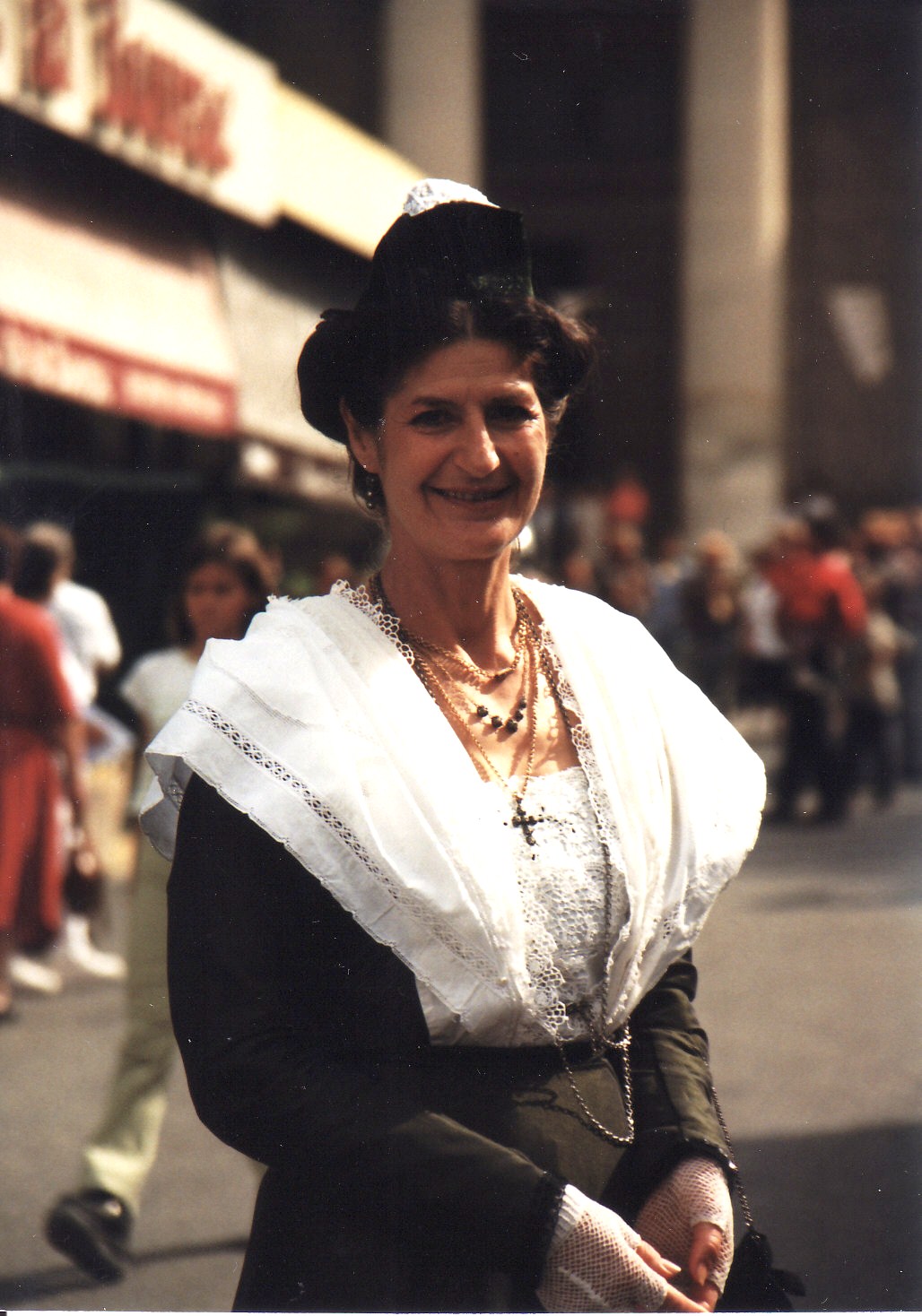
We had been to St. Remy on their regular market day. Vendor stalls of every kind radiated out from the town square into the side streets.  Everything from bras to bananas to baskets was available and attractively displayed: clothing, antiques, art work, jewelry, fabric, and flowers. There were foods of all kinds, enough to make a serious foodie weep for joy to see them, or for sorrow that so many of them are not available at home. A few days later that square was jammed with carnival rides and games. I don’t know how they wedged them all in there. We wandered around town, entertained by a strolling brass band. Everywhere we looked there were folks in Provençal costume, all very happy to pose for pictures. One lovely woman, dressed like van Gogh’s L’ Arlésienne, chatted with us and described the various parts of her costume. 

For lunch we went a bit south of town to Glanum, the site of an ancient Roman city. Their restaurant offers lunch as the Romans would have enjoyed it. The dish of the day was the Domitia Plate, four different things: a dish of mashed chick peas with olive oil, pepper, and cumin; roast pork with an absolutely delicious sauce of honey and - yes! - anchovies; duck pâté on toast; and melon chunks tossed with olive oil, cumin and coriander. I don’t think the Romans lacked for culinary delights if they ate a meal like that one.  

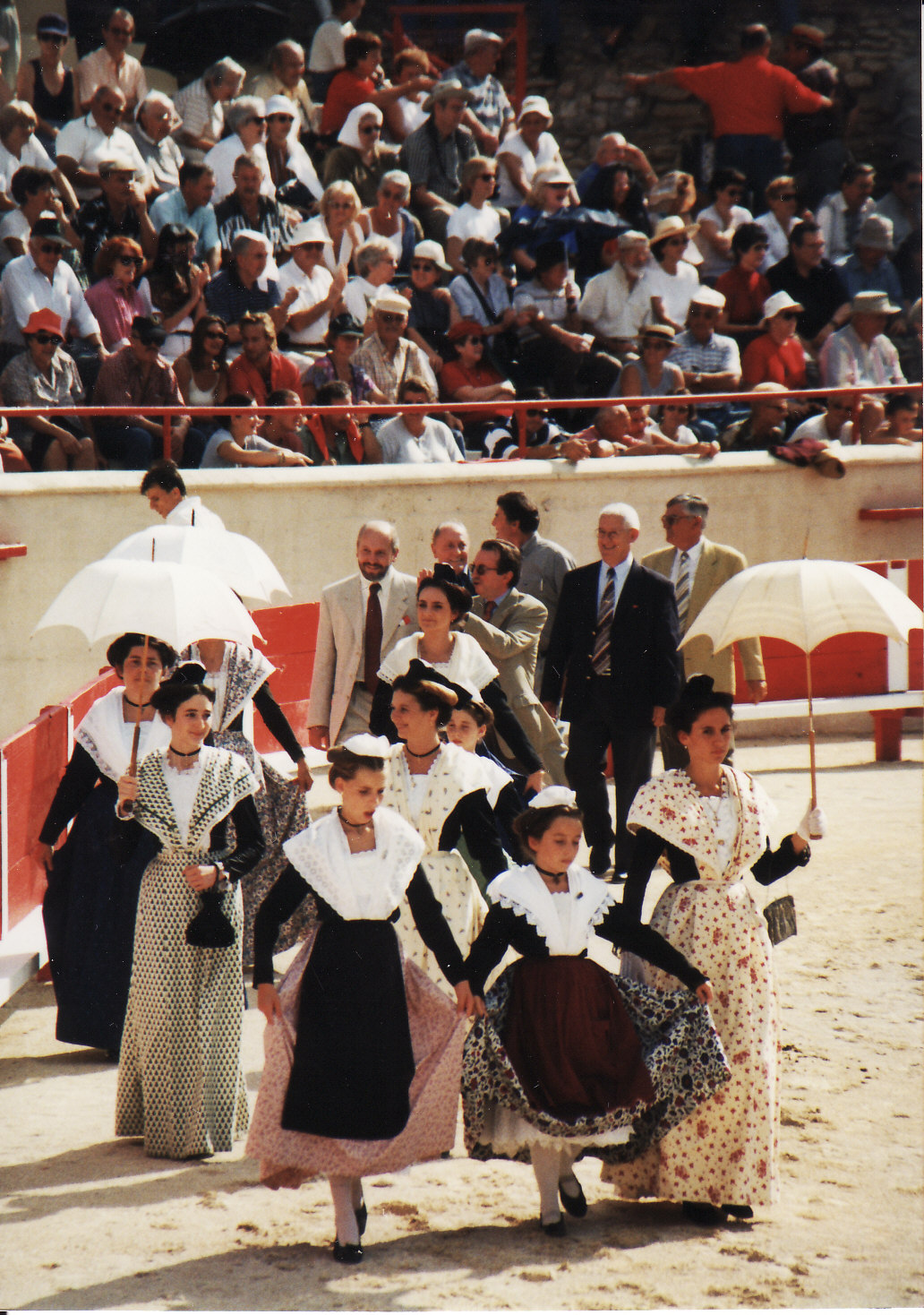
Lunch under our adjusted belts, we went back to the town arena to see the Camargue’s version of the bullfight. Much to our surprise, it turned out to be the grand re-opening of the arena, with all the local dignitaries on hand for some pomp and circumstance. The speeches and entertainment were accompanied by the same band, now in more elaborate uniforms. There was an amazing group of whip-wielding men performing a rhythmic, snapping, routine. We wondered how they kept their wrists in shape for such strenuous tricks. A few more speeches, and then, to our delight, in came all of the Gardians on horseback, performing a practiced quadrille, and the costumed folk we’d seen that morning. From little girls to elegant gentlemen and ladies, including L’Arlésienne, they did a measured promenade and a lively version of a May-pole dance.

Before ‘Inauguration’ we had located our ticketed seats and decided it was going to be a tight squeeze. Some folks had already spread out into our numbered spaces, so we hopped up and sat on the top wall where the view was unobstructed and perfect for taking pictures. Our move delighted some of the locals already sitting up there. They’d rarely seen tourists at such a local event. After the Inauguration the ‘Course’ began. Despite the language barrier - I’m only a bit conversant in French - they got over to us all about what would be happening.


This is a bull fight where the bull has all the advantages. The ‘fight’ is called la Course à la Cocarde, or the Course Camarguaise. Teams of agile men, dressed in white, vie for the cockades or knots tied to the bulls horns. The ‘raseteurs’, the ‘shavers’, wear a small rake-type device over their knuckles, and they dart in to meet a charging bull, trying to rake or snatch the knotted string from the bull’s horns. The team winning the most knots wins. 

The bulls are a small breed but their horns are wicked. They run the teams all over the arena. You can bet those men are extremely quick. Twice we saw a bull jump over the arena’s guard wall in pursuit of a raseteur.  Many times they chased men who had to jump up on the guard wall and then up onto the concrete wall of the stands in order to evade those horns.  But when the bull starts to tire, when he starts to foam at the mouth, he is quickly retired and a fresh bull enters the fray. Do the tired men get replaced? Mais non! Certainly not! At the end we couldn’t tell which team won and which lost, but it can be said, beyond a shadow of a doubt, that for several hours there was never a dull moment. 

Exhausted and elated, we headed back to our château home-away-from-home to celebrate our day with a bottle of good Rhone wine. À votre santé! 

Sunday, July 10, 2011

IT'S NICE TO BE NICE

We recently had a visit from a lovely nurse who is with the Homecare of Lancaster. She couldn’t believe that we were from New York. Evidently, in the course of her work here in several of our Sun City Carolina Lakes homes, she has run into some very unpleasant people from above the Mason-Dixon Line.  Not everyone from the north has given her a hard, rude time, and some from the south could also use a lesson or two in manners, but we surprised her by being so nice. SCCL people I ask you: what is with that?     

This woman, highly trained, supremely efficient and kindness itself, was in our home to help us - not the other way ’round. She has a lovely southern accent, as you would you expect from someone born and bred in Lancaster. She said she feels as though northerners view folks with southern accents as working with less than a full set of brains. But you know, to her, we are the ones with the accents. (Accents are funny things. Very often in the early hours of the day in the Lake House pool there are five of us with accents: one New Yorker, one Georgia Peach, one English-born, one German-born, and one Frenchman.  O.K., which one of us has the accent? And remember, two of those five speak more than one language. How many do you speak?) Accents tell others where we were born, not who we are and how much we know. That can be told by what we say and how we say it.           

I know that many of SCCL’s residents think nothing of giving a hard, rude time to the folks at the Lake House desk. The denizens of the desk say that a thick skin has to go along with the job, but that’s a sad commentary on how we live here. I can imagine myself manning the desk and spying some grim-looking resident coming up to face me. I’d think “Oh boy, here comes trouble.”  How much nicer it would be for me to greet a smiling resident with a sincere “How may I help you.”  If they said “I’ve got a big problem here and I need you to help me solve it,” their smile would already have put me on their side. Simple as that: it’s nice to be nice.

The stories told by the nurse or desk personnel are not unique. Many of our local merchants tell similar stories. In my humble opinion folks, this rude, ‘I’m better than you are’, ‘you are here to serve me’, ‘the world owes me a living’ attitude has got to stop. You are giving the rest of us a bad reputation. Ain’t none of us so wonderful, so rich, so absolutely right, or even so old, that we can be rude and thoughtless to others, no matter what their status, station or calling in life. 

Think of, truly digest, the words of the Golden Rule: Do unto others as you would have them do unto you.   Get beyond your pain or your problem, be pleasant if it kills you, and help will be given to you sooner and with a smile.  ‘As you would have them do unto you’ - fate forbid some folks should think to be as rude in return as some are to them. That would be nasty, and it might even come to fisticuffs. (Oooo, can I watch?)  

There are all sorts of mottoes and sayings that could be trotted out to tell you to have more regard for others - you probably know them all.  These two will suffice: ‘Remember the Golden Rule’, and ‘It’s Nice to be Nice’. Now - go to your mirror and practice your smile.