Monday, July 25, 2011

A (very) SHORT GUSTATORY TOUR OF ITALY...

...in honor of Lasagna Awareness Month

Funivia from Rapallo to Montallegtro
July is Lasagna Awareness Month? Are they serious? Why should we be ‘aware’ of lasagna? Isn’t everyone? Just who came up with this? The cheese industry? The pasta industry? The tomato industry? No, not the Italians. They’d celebrate all food and wine, not just one tasty dish. Who would own up to wanting to celebrate this in July: this is a dish for the cooler weather. I never had lasagna in Italy, but all this food talk reminds me of what I did have.

I have to admit that I’m partial to Italian food. You will appreciate, of course, that the best pizza I ever had was in Italy: a wonderful Margherita pizza we enjoyed at lunch in the Piazza della Signoria in Florence. Or was it at that restaurant in Rapallo? So many pizzas, so little time.

The best way to experience any country is to go with a native. We had this luck in Liguria. Liliana, a colleague of our former daughter-in-law, took us on a gustatory tour. In Chiavari we enjoyed farinata, a pizza made with chick-pea flour. Further west on the French Riviera this is called socca. In Santa Margherita we had, among other delights, a salad of fresh tomatoes, fresh mozzarella, and fresh anchovies. I’ve come to love certain ‘iffy’ foods like escargot and mussels, when I was embarrassed to admit I’d never tried them before. Not wanting to say that I didn’t like anchovies, I took a bite - heaven! Those fresh fellows were absolutely delicious!
In Portofino Liliana knew everyone. She got our boat a berth right at the harbor master’s dock, and then took us for a tour and a decadent dessert of ice cream covered with berries and other fruit.  In Vernazza, in the Cinque Terra, we had Ligurian pasta, trofi al pesto, and an unlabeled bottle of local white wine that was just fabulous.

Pansotti alla Noce
My most memorable meal was in Rapallo. Le Santuario de Nostra Signora di Montallegro (say that three times fast!) is a beautiful church, a place of pilgrimage, reached via funivia, a cable car that takes you up a small mountain. On the way from the car terminus to the church we smelled a wonderful aroma coming from a hotel along the way. Liliana stopped in and ordered our lunch, to be made to order for us, for our later return. That lunch is probably the best one I ever had. The dish was Pansotti alla Noce, and my travel diary says “to die for!” On handkerchief-like squares of pasta they spread a mixture of chopped herbs, including borage, and vegetables. The pasta is folded up around the filling so it stays together in cooking, and there are many layers to each piece. They are served covered in a sauce of walnuts and cream. The aroma of that sauce is what had enticed us on our way. The funivia stops service until two in the afternoon, so we had a long, leisurely lunch. Some wine, some cappuccino, some dessert. I could have rolled down that mountain on my own.

So, back to lasagna. Go on line and check out lasagna and its history. There are northern versions, mainly using béchamel or white sauces, and southern versions using tomato based sauces.   Basically, it is sheets of pasta layered with sauce, cheese, perhaps meat, and other ingredients, and all baked in a dish - a lasanum. Google ‘lasagna’ and you come up with hundreds of versions.  You really can’t go wrong.  Lasagna is on most folks lists of favorite comfort foods - mine too!


Thursday, July 14, 2011

SUNDAY IN THE CAMARGUE

Today, Frenchmen all over the world are celebrating Bastille Day - Le Quatorze Juillet - and in honor of the day I'm posting a story about a wonderful day we spent in St. Remy-de- Provence.  The pictures here are some of my own.


It was a serendipitous decision to spend a Sunday in St. Remy-de-Provence during the annual festival in celebration of their saint’s day. The day began with the running of a bull through the town. Most spectators stood behind temporary barriers, but some were up trees or on walls or light poles. The true ‘crazies’ just stood about and scattered when the bull came down the street.  It was hilarious to see them panic when the bull turned and started back toward them.  A large group of Camarguaise horsemen, the Gardians, dressed in black and carrying trident spears, trotted along behind on their white horses, generally herding the lone bull in the same way they herd the semi-wild horses and bulls of the region.

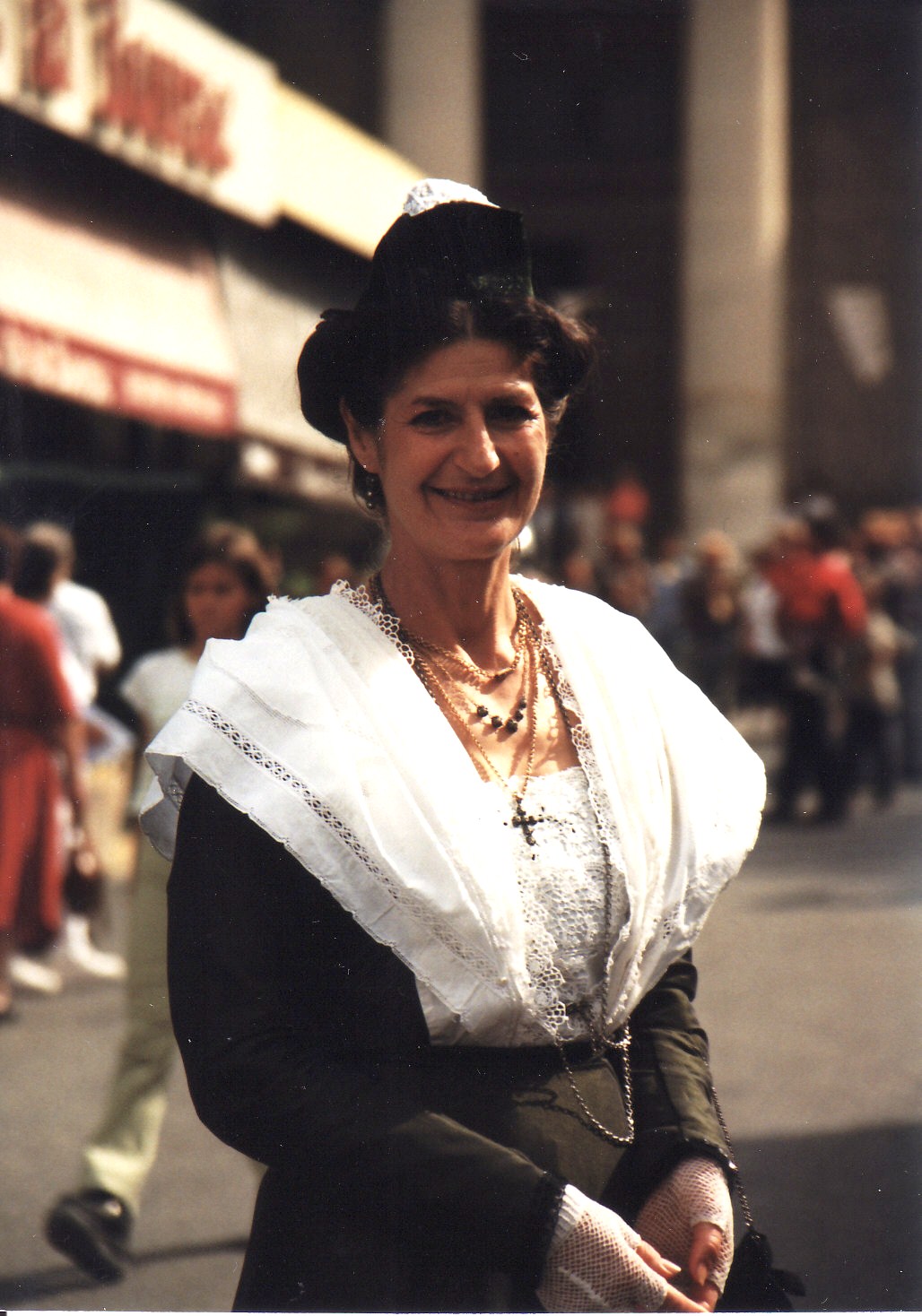
We had been to St. Remy on their regular market day. Vendor stalls of every kind radiated out from the town square into the side streets.  Everything from bras to bananas to baskets was available and attractively displayed: clothing, antiques, art work, jewelry, fabric, and flowers. There were foods of all kinds, enough to make a serious foodie weep for joy to see them, or for sorrow that so many of them are not available at home. A few days later that square was jammed with carnival rides and games. I don’t know how they wedged them all in there. We wandered around town, entertained by a strolling brass band. Everywhere we looked there were folks in Provençal costume, all very happy to pose for pictures. One lovely woman, dressed like van Gogh’s L’ Arlésienne, chatted with us and described the various parts of her costume. 

For lunch we went a bit south of town to Glanum, the site of an ancient Roman city. Their restaurant offers lunch as the Romans would have enjoyed it. The dish of the day was the Domitia Plate, four different things: a dish of mashed chick peas with olive oil, pepper, and cumin; roast pork with an absolutely delicious sauce of honey and - yes! - anchovies; duck pâté on toast; and melon chunks tossed with olive oil, cumin and coriander. I don’t think the Romans lacked for culinary delights if they ate a meal like that one.  

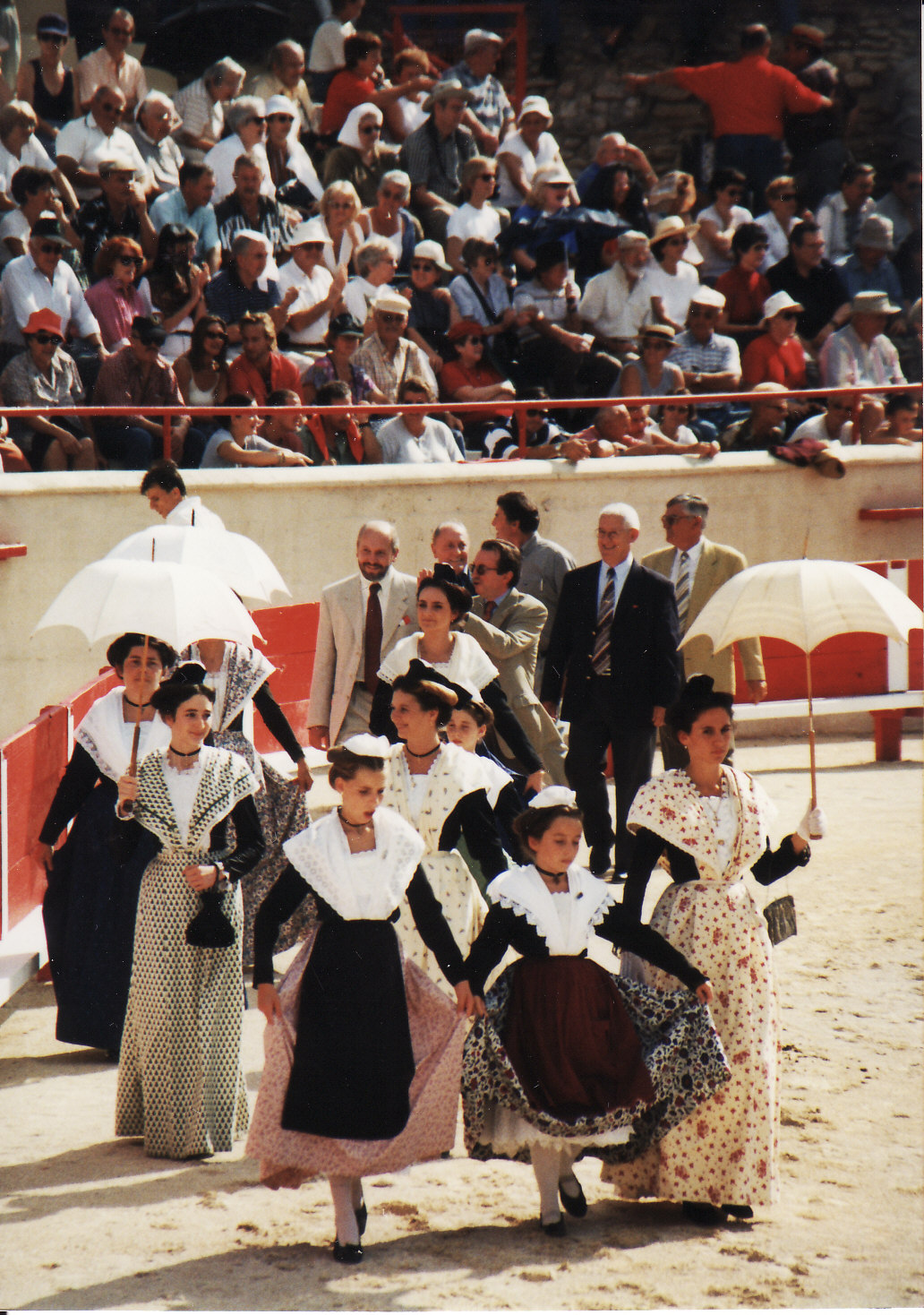
Lunch under our adjusted belts, we went back to the town arena to see the Camargue’s version of the bullfight. Much to our surprise, it turned out to be the grand re-opening of the arena, with all the local dignitaries on hand for some pomp and circumstance. The speeches and entertainment were accompanied by the same band, now in more elaborate uniforms. There was an amazing group of whip-wielding men performing a rhythmic, snapping, routine. We wondered how they kept their wrists in shape for such strenuous tricks. A few more speeches, and then, to our delight, in came all of the Gardians on horseback, performing a practiced quadrille, and the costumed folk we’d seen that morning. From little girls to elegant gentlemen and ladies, including L’Arlésienne, they did a measured promenade and a lively version of a May-pole dance.

Before ‘Inauguration’ we had located our ticketed seats and decided it was going to be a tight squeeze. Some folks had already spread out into our numbered spaces, so we hopped up and sat on the top wall where the view was unobstructed and perfect for taking pictures. Our move delighted some of the locals already sitting up there. They’d rarely seen tourists at such a local event. After the Inauguration the ‘Course’ began. Despite the language barrier - I’m only a bit conversant in French - they got over to us all about what would be happening.


This is a bull fight where the bull has all the advantages. The ‘fight’ is called la Course à la Cocarde, or the Course Camarguaise. Teams of agile men, dressed in white, vie for the cockades or knots tied to the bulls horns. The ‘raseteurs’, the ‘shavers’, wear a small rake-type device over their knuckles, and they dart in to meet a charging bull, trying to rake or snatch the knotted string from the bull’s horns. The team winning the most knots wins. 

The bulls are a small breed but their horns are wicked. They run the teams all over the arena. You can bet those men are extremely quick. Twice we saw a bull jump over the arena’s guard wall in pursuit of a raseteur.  Many times they chased men who had to jump up on the guard wall and then up onto the concrete wall of the stands in order to evade those horns.  But when the bull starts to tire, when he starts to foam at the mouth, he is quickly retired and a fresh bull enters the fray. Do the tired men get replaced? Mais non! Certainly not! At the end we couldn’t tell which team won and which lost, but it can be said, beyond a shadow of a doubt, that for several hours there was never a dull moment. 

Exhausted and elated, we headed back to our château home-away-from-home to celebrate our day with a bottle of good Rhone wine. À votre santé! 

Sunday, July 10, 2011

IT'S NICE TO BE NICE

We recently had a visit from a lovely nurse who is with the Homecare of Lancaster. She couldn’t believe that we were from New York. Evidently, in the course of her work here in several of our Sun City Carolina Lakes homes, she has run into some very unpleasant people from above the Mason-Dixon Line.  Not everyone from the north has given her a hard, rude time, and some from the south could also use a lesson or two in manners, but we surprised her by being so nice. SCCL people I ask you: what is with that?     

This woman, highly trained, supremely efficient and kindness itself, was in our home to help us - not the other way ’round. She has a lovely southern accent, as you would you expect from someone born and bred in Lancaster. She said she feels as though northerners view folks with southern accents as working with less than a full set of brains. But you know, to her, we are the ones with the accents. (Accents are funny things. Very often in the early hours of the day in the Lake House pool there are five of us with accents: one New Yorker, one Georgia Peach, one English-born, one German-born, and one Frenchman.  O.K., which one of us has the accent? And remember, two of those five speak more than one language. How many do you speak?) Accents tell others where we were born, not who we are and how much we know. That can be told by what we say and how we say it.           

I know that many of SCCL’s residents think nothing of giving a hard, rude time to the folks at the Lake House desk. The denizens of the desk say that a thick skin has to go along with the job, but that’s a sad commentary on how we live here. I can imagine myself manning the desk and spying some grim-looking resident coming up to face me. I’d think “Oh boy, here comes trouble.”  How much nicer it would be for me to greet a smiling resident with a sincere “How may I help you.”  If they said “I’ve got a big problem here and I need you to help me solve it,” their smile would already have put me on their side. Simple as that: it’s nice to be nice.

The stories told by the nurse or desk personnel are not unique. Many of our local merchants tell similar stories. In my humble opinion folks, this rude, ‘I’m better than you are’, ‘you are here to serve me’, ‘the world owes me a living’ attitude has got to stop. You are giving the rest of us a bad reputation. Ain’t none of us so wonderful, so rich, so absolutely right, or even so old, that we can be rude and thoughtless to others, no matter what their status, station or calling in life. 

Think of, truly digest, the words of the Golden Rule: Do unto others as you would have them do unto you.   Get beyond your pain or your problem, be pleasant if it kills you, and help will be given to you sooner and with a smile.  ‘As you would have them do unto you’ - fate forbid some folks should think to be as rude in return as some are to them. That would be nasty, and it might even come to fisticuffs. (Oooo, can I watch?)  

There are all sorts of mottoes and sayings that could be trotted out to tell you to have more regard for others - you probably know them all.  These two will suffice: ‘Remember the Golden Rule’, and ‘It’s Nice to be Nice’. Now - go to your mirror and practice your smile. 

Saturday, July 2, 2011

WHAT'S IN A NAME?

Today every Tom, Dick and Harry has a last name, but that wasn’t always so.  I doubt that our ancestors were named Fred and Barney, but until they started to sort themselves out and create a hierarchy, I’d surmise that everyone needed only one name.  For millennia, rural people were so far out of town that they knew everyone in the area.  It was when they congregated in cities that they had to tack identifiers on to their simple names.

Once folks realized there were others around with their name they began to tack on the name of town they were from.  Thus we have George Washington, whose forebears were from Washington in England, or James Galway, from Ireland. In English we don’t use the ‘from’, but among others, the German Von, the French or Spanish De, or the Italian Da, mean ‘from’. Think of Von Richtofen or DaVinci. 

Meanwhile, back at home, the population was growing.  Tom wasn’t the only Tom in town, so in many places he became Tom Johnson, the son of John.  In Arab countries a son was ibn-, in Hebrew he was ben-, they’re almost the same. In Gaelic, Mac or Mc means son, and O’ means grandson. Could a Scots-Irish lad be O’MacDonald?  In the Scandinavian countries a son was -son sometimes -sen. Erik the Red was Erik Thorvaldsson. A daughter was -dóttir or -datter. This is still used in Iceland, where Vigdís Finnbogadóttir was the world’s first democratically elected female head of state.

In other instances, instead of being a son of someone, folks added their profession to their given name. They became Tom Baker, Margaret Thatcher, Maurice Chevalier, or Robert Allen Zimmermann. One ‘n’ or two, a zimmermann is a carpenter, but we know this one as a singer: Bob Dylan. They might have had a characteristic that distinguished them: if they were redheads they might be Russo in Italy or Rousseau in France. If they lived by a lake or pond they became Veronica Lake or James Pond. If their father worked for a bishop, abbot, or priest, or if their father was one, they might use that as their surname.  Is that how that comic became Joey Bishop?  Nah, his last name was Gottlieb, which is German for God’s love, and that might have begun as a nick name.  

In 1979, the United Nations adopted a measure that states, among other things, that there should be equal rights in the transmission of family names. Parents can decide to give their children either the name of the father or mother, or a hyphenation of both – although no more than two names can be hyphenated. I wonder what happens when a Smith-Wong marries a Patel-Jones. Though in one form and one place or another this has been going on for a long time, many couples are now deciding on the wife keeping her own name and their children having a combined surname.  When James Pope marries Anne Sicola, their children’s surname will be Pope-Sicola.

So, surnames came from relationships, towns, locations, occupations, even nicknames. There are many whose origins remain a mystery. It’s said that the name Ryan can’t be traced, but that’s the luck o’ the Irish for you. Surname is from the Old French ‘sur’, meaning ‘super’ or ‘on’ or ‘on top of,’ and ‘nom’, meaning name. We’ve just skimmed the surface of surnames.  Names from our western European heritage, once so prevalent in the States, have been joined by a United Nations of names, and their origins are interesting and very intriguing.


Wednesday, June 29, 2011

ON BECOMING A CURMUDGEON


I don’t think I’m quite there yet, not quite ready to fill Andy Rooney’s shoes, but as I get older I feel more and more curmudgeonly. Some of the topics flying around SCCL lately just bring out the curmudgeon in me.

Wrong and Right
Have you ever heard this one: “Dogs are like string: every yo-yo wants one”?  We’ve got a few yo-yo’s around here, that’s for sure.  Most folks will say “oh, you don’t like dogs” or “you don’t understand”.  
Wrong: I like dogs. I’ve got four wonderful grand-dogs. I know something about the canine family, and I especially admire large, working dogs. (I do sometimes wonder at the sight of tall, hefty men out walking their miniature dogs. I want to yell “get a real dog” at them, but I suppose a little dog, however yappy they are, can be loved as much and mean as much as a large one.)   
We had several dogs when I was growing up. One memorable dog was a juvenile Great Dane that my uncle brought to us when we first moved to the countrified wilds of Nassau County, Long Island, from the civilized, citified sanity of Queens, New York. He thought we needed a dog for protection. After a week or two, my Mother decided she’d risk life and limb and the security of the family, rather than to have to feed that dog. I learned about the economic impact of dogs, and pets in general, at an early age. I love dogs - just for other people. I do not want to have to spend retirement funds to feed them, vet them, kennel them when we travel, or walk them on a schedule that’s theirs, not mine, much less scoop their poop. Other people are welcome to do it, just not me. But I do like dogs. 

Right: I don’t understand. Here’s where the ‘yo-yo’ comes in: I don’t understand some of the dog owners here at Sun City Carolina Lakes who have so little respect for their fellow homeowners that they don’t curb their dogs and/or don’t clean up after them. They’d have a fit if another dog walker left a load on their property.
I could not believe it when we were told of folks who dump their doo-bags (to be distinguished from doo-rags) down the drainage grates in our streets. For Pete’s sake, the drainage grates are not sewers. The water ends up in our own little Carolina Lakes.
And another thing: I don’t understand the people who think the SCCL HOA is there to provide their personal supply of doo-bags. (I also don’t understand why the HOA pays for these bags in the first place. A nice little addition among many other deletions?) The HOA puts the bags out and they disappear before you can say scoopy-doo. How cheap can these folks get? I realize that some people are just built this way, but I wish they weren’t. Well – I could go on, but…

This is just one of the things that regularly strike me as being fodder for a good grump session. I find that with age I haven’t gained more wisdom: I’m just viewing things with a more cynical eye, with a little more skepticism, and with a lot more disbelief. I read or see something that strikes an off-key note, and it all sets me grumbling and complaining. I hope to be writing more about such things. It will take a while more for me to become a full blown curmudgeon, but I’m working on it - it’s such fun.

Sunday, June 26, 2011

TO SLEEP, PERCHANCE TO DREAM...


...ay, there’s the rub – the rub for us seniors, that is.   Very rarely can we say we slept like a baby because we usually sleep like a senior.   We have a hard time getting to sleep and staying asleep.

Some studies say that a third of Americans don’t get enough sleep, others say it’s about 49%. Wherever you look they’re throwing numbers at the problem.  We all know that good sleep is essential to our health and well-being and that our ability to sleep changes as we age.  Health problems can plague us and keep us awake at night. They say that you should establish regular, calming routines to lull yourself to sleep.  I say “Nonsense! It’s time to shake it up, not wake it up.”

You may be able to think up your own routine-shaking changes; meanwhile here are some you may want to try.  As someone’s Mama might have said: “It couldn’t hurt.”

Don’t You Worry ‘Bout a Thing
Flush your worries before you turn off the bathroom light or they’ll come in to bed with you. Don’t worry about the kids and grandkids. Lying awake to worry on their behalf won’t make any difference in the long run.  Try not to think about health problems: worrying about them isn’t an accepted medical treatment. Don’t make any major decisions while you’re trying to get to sleep.  Make decisions just after waking up when your brain is fresh.

The mind’s eye is a useful tool.  Don’t just lie there: think of something. Try reading an interesting article before bedtime.  Read a bit from magazines like Smithsonian, National Geographic, Popular Mechanics, or whatever publication caters to your interests. Think about any recent book you’ve read or movie you’ve seen: what happened after The End?  Revisit great places you’ve been or rerun great times you’ve had with family or friends.  Start the plot outline for a book you could write. (You might want to keep a pad and lighted pen on your night stand.) As you prepare for bed be planning the topic for your train of thought – let the train take you away into sleep.

Don’t Knock it if You Haven’t Tried It
Eat two slices of bread before bed – before you brush your teeth, of course.  Just bread, no butter or jam, but maybe a teaspoon or two of honey which is said to be a sleeping aid.

Sleep in the buff.  Nightgowns and PJ’s can be constricting and lumpy, and you have to fight with them when you turn over, and you get aggravated and…!  Try a night without them.

Keep cool. Turn down the thermostat at night in the warm weather.  Which comes first: your sleep and your health or the electric bill?  Keep cool in winter too.

Move the alarm clock.  Turn its face away from you so that you don’t watch the clock and agonize over all the time you think you’ve been awake.  Ignorance is bliss.

Get rid of your old-faithful easy chair.  If you’re one of those who fall asleep in front of the TV in your comfy chair you're robbing yourself of proper sleep in bed.  Rearrange your living room if you have to.  If TV bores you to sleep why watch it?  If you’re falling asleep go to bed.  You might want to change your regular bedtime to an earlier hour.  

When I was little I usually had to take a nap, especially if were doing something special that night. My Mother always told me that I didn’t have to sleep but did have to rest.  Nine times out of ten I’d fall right to sleep.  Don’t worry about sleeping – get it off your mind: just rest.  Try some of the sleep routine-shaking changes above.  They might just work for you.


Monday, June 20, 2011

DO YOU KNOW ROY G. BIV?


Do you know Roy G. Biv? You might remember him from high school General Science class. He’s the mnemonic we learned in order to remember the colors of the rainbow: Red, Orange, Yellow, Green, Blue, Indigo, and Violet. “My heart leaps up when I behold a rainbow in the sky”, said Wordsworth – so says everyone, of course.  We all thrill watch of that awesome sight.  We all love colors. In these days of digital photography, high definition TV, and the internet, color almost explodes around us. It has become very important in our homes, gardens, and workplaces.  

Color is very significant to all of us, and we react intuitively to it. In western culture there is almost universal agreement on certain colors evoking specific states of mind. Red is, of course rage – we “see red”, and it is associated with blood and sin: The Scarlet Letter comes to mind. Someone is said to be “green with envy” or “yellow bellied” – not very nice associations. A whole school of music is devoted to the Blues. Have you ever heard of someone being in a “brown study”? He’s in deep thought or even daydreaming.

Then there is the ominous “black as death.” Curiously though, where westerners choose black as the color of mourning, white is the color chosen in the Orient. Easterners intuitive sense and use of colors is usually quite different than those of the west. Purple is the color of royalty in the west, yellow in the east.  Europeans don’t use colors to represent the directions, but the south, just one of the four directions, is seen as yellow by the Maya, red by the Chinese, and white by Native Americans. 

Science doesn’t know when we first gained it, or even when we lost it, but some say we still have the ability to see auras in other people. The colors seen as auras differ in meaning from both the eastern and western associations, with the exception of the colors gold and pink.  A golden yellow aura or halo, seen in paintings and icons and other depictions of holy people, signifies spiritual achievement, joy, and even a great intellectual ability.  Pink is pink everywhere you go: a happy, balanced state of being, being “in the pink.”  

SHOW YOUR COLORS 
Throughout history, in so many different ways, it became important to “show your colors”. From times when very few if any of the people were literate, various color systems, used along with significant symbols, were devised to let them know who was who and what was what.  It is so interesting a subject that the theory and study of how cultures communicate with color, signs, and symbols has developed into a formal field of academic study. Heraldry and symbolism told a tale. Colors and crests, plaids and patterns distinguished one side from the other in combat. Today’s street gangs know the importance of colors. Liturgical colors used on vestments reminded the people of the upcoming events to be celebrated.  Standard symbols on great stained glass windows told stories to people who couldn’t read.  

Say “show your colors” to an American and they’ll think of red, white and blue.  Is it any wonder that we are partial to flags showing these same colors? Think of the flags of England, France, Norway, or Holland. I really like the flag of Nepal – it’s red, white, and blue, but it isn’t flag shape.  And how ‘bout that Lone Star flag of Texas? The designers of the Olympic flag diplomatically joined five rings, symbols of unity, one for each continent, and colored blue, yellow, black, green, and red.  At least one of those colors appears on every national flag.      

My earliest, favorite, happiest association with color, and perhaps yours too, was with a box of crayons – Crayola, naturally.  Just the smell of a box of crayons today brings back all sorts of memories, especially the times when my first grade teacher chose me to help give out the crayons for art period. I am still the proud owner of my own 48 count box of Crayolas. I say “my own” because I keep another, well used box of crayons for my grandchildren.  Heaven forbid they touch my box! 


Monday, June 6, 2011

AUDUBON

This is the original of an article edited and posted in Living @ Sun City Carolina Lakes. Audubon's is a name we all recogize, but most of us know little about his life. I'm pleased that I was asked to write the article.
The first picture is mine - not Audubon's, of course.


When she was born in 1970, my goddaughter’s grandparents gave her a lifetime membership in the Audubon Society.  Along with the membership came a beautiful, large Audubon print – not one of the originals, of course, but a good one never the less.  It was probably the first time I saw an Audubon print, and I’ve admired them ever since. 

There is something very appealing about the way Audubon depicted the birds, and later the animals, of North America.  Previously, it was the custom of naturalist painters, who dismissed his work as inferior, to depict the subject animal with very little to distract from its pure presentation. They were as lifeless as stuffed specimens in a museum drawer.  Audubon enlivened his pictures by including the subjects and their natural habitat as well. Not just siting subjects, but subjects in motion:  Peregrine Falcons tearing into a goose with feathers flying, or a Louisiana Heron preening its feathers.  They became pictures to collect, pictures to study, pictures to enhance a home.         

John James Audubon was born in what is now Haiti in 1785, and was raised in France.  He was evidently an accomplished, handsome young man, riding, dancing, and playing the violin.  He was interested in his natural surroundings, especially the birds, and began drawing what he saw and collected. Sent to America when he was eighteen to oversee one of his father’s interests, he lived the life of a woodsman and naturalist as well as that of a businessman. Over the years he continued collecting and recording his findings, traveling widely through the north-eastern and middle-eastern states. He was the first person in North America to band birds.  He tied yarn to the legs of Eastern Phoebes to see if they returned to their nests each year.

Though sometimes very successful in business, his own ventures finally failed when he was in his early thirties.  He developed an idea he’d had for a while, and began to work on what would become The Birds of America. He traveled through territory new to him, particularly Alabama, Florida and Mississippi, recording the birds and habitats there.   As he began to do the drawings and paintings, attempting to complete one subject a day, he had to hire hunters to collect specimens for him.  At one point he learned a new painting technique and redid all his previous work.  Along the way he discovered twenty-five new species and 12 sub species, and recorded for us some birds, such as the Carolina Parakeet and the Passenger Pigeon, that are now extinct.

After having the work rejected here, on good advice he took it to England in 1826. It was an immediate success.  The English took to anything relating to wild America. By subscription, lectures, and other means, he raised enough money to begin publishing the series.  Though later issues would be printed on smaller paper, the originals were printed on paper about 29 by 40 inches, showing all the birds life size.  Around 200 sets of 435 plates each were produced until the last print came out in 1838.  Printing the plates and having them hand-colored was extremely expensive. The prints were sent out, five plates at a time, unbound and without text to avoid having to furnish free sets to the public libraries in England. The text, Ornithological Biography, was published separately in Scotland in five volumes, the last of which came out in 1839.


In December of 2010, Sotheby’s sold a complete set of The Birds of America for a record $11.5 million, including the commission.  I know Audubon could have used a piece of that pie.


Thursday, May 26, 2011

THE LOST (But Sometimes Found) ART OF SERENDIPITY


Ah, serendipity. All by itself, the word strikes a pleasant note. We use it to mean the knack of making desirable discoveries by accident. Webster’s tells the first use of this word was by Horace Walpole (1717-92). In a letter to the American educator Horace Mann, Walpole said he formed it from the Persian fairy tale The Three Princes of Serendip, whose heroes "were always making discoveries, by accidents and sagacity, of things they were not in quest of." Serendip is an old name for Ceylon, now Sri Lanka.
 
Serendipity can’t be described as just dumb luck. The real secret to it is to be on the alert and ready for opportunities to do something different.  My husband and I have had many serendipitous experiences in our travels.  One fine May afternoon, way back when, after our first pub lunch and a lovely jaunt around southern England visiting Bodiam Castle, Battle (the Battle being the Battle of Hastings) and Rye, we got back to our base in Tenterden, Kent. We wandered off the High Street to the railroad station, part of the Kent and East Sussex Railway. We were admiring a lovely old train when we were approached by a charming man who asked us if we would like an adventure. Later we learned that the restoration and preservation of the light railway and its rolling stock was an entirely volunteer effort, and that part of their fund raising effort was to serve dinner in an authentically restored Pullman car. Here’s the serendipitous part: someone had had to cancel several bookings he’d made for dinner on the Wealden Pullman, and there were a few reservations on offer. We jumped at the chance.

Returning to our B & B to change into proper dinner attire, our host congratulated us on our fortune, admitting that he’d not yet had his own name come up on the waiting list. The bookings for this popular excursion, then run only on warm-weather Saturdays, were next to impossible to get. We understood why as the trip and the dinner progressed. Rolling serenely along through the countryside, seated at a table for two, we enjoyed a delicious four-course meal, served to perfection by perfectly-uniformed volunteer waiters, complete with aperitifs and wines, port and cigars. We passed on the cigars. It certainly was just by accident that we turned up at the railway station at the right time, and I don’t think it took too much sagacity to take the chance for a different dining experience: we had to have diner no matter what. The picture I took of Frank, seated across the table, shows a smile of absolute delight and contentment. 
 
Serendipity was disembarking last from a cruise ship in Bergen, Norway, but finding ourselves first to be shown to a waiting taxi. Serendipity was arriving at the ornately Victorian Papplewick Pumping Station in Nottinghamshire on one of the few days in the year when they bring James Watt’s huge beam engines up to full, working steam.  It was deciding to go to a bullfight in St. Remy-de-Provence, and finding ourselves at a wonderful, elaborately-costumed ceremony on what turned out to be the re-opening day of the refurbished arena.

Of course we’ve missed what might have been serendipitous moments by being there too late: “you should have been here last week,” or too early: “can you stay until next week when…comes to town?” But we never dwell on what we might have been. After all, it isn’t as though we were sitting idly, twiddling our thumbs and waiting for things to happen. No, we’ve been very serendipitous in that respect.

Tuesday, May 17, 2011

EGGS ENCORE


In the first essay for May you read that eggs are back in favor, how easy they are on your budget, and the basic ways to cook and enjoy them. Now we’re on an egg-stended journey to see how eggs figure into our lives in other than culinary ways.

Never mind which came first, the chicken or the egg, the egg was around long before man even thought of that question.  The recurring egg-chicken-egg cycle was and still is fascinating. From ancient times the egg was revered in most cultures as a symbol of rebirth. The egg has inspired everything from the original L’eggs package, to jelly beans, to those fabulous Fabergé eggs.             

Birds eggs come in all sizes, from the huge ostrich egg, equal to 18 to 24 chicken eggs, down to the minute bee-hummingbird’s egg, no bigger than a pea.  Colors: Easter eggs aside, eggs come in a variety of colors from the most common white to black, with a rainbow of colors in between. Some are spotted or mottled, some are plain.  All are beautiful.  All are edible. Most eggs are egg-shaped, but the eggs of guillemots and some other marine birds are pear shaped and pointed so that they will roll in a circle, but won’t roll off the cliff ledge where they are laid.

One of the earth’s perfectly packaged foods, enjoyed by most omnivores, eggs are nutritious and delicious. They are useful in cooking and the manufacturing of products such as cake mixes, salad dressings, noodles, and cosmetics and medicines.  They have antimicrobial properties and antioxidant properties. The whole egg is useful, from the whites and yolks on out to the shells which can be ground for fertilizer and animal feed.
 

Here are some egg-cellent Questions and Answers about eggs:

What connection does Michelangelo’s Last supper have with eggs?  The mural was painted in egg tempera – a mixture of pigments, oil, vinegar, and egg yolk.

What connection do eggs have with your T-bone steak?  They aid in the preservation of bull semen for artificial insemination.

What connection do eggs have with your flu shot? Fertile eggs are used in the manufacture of vaccines.  Eggs are also used in testing to feed laboratory animals and as a growth base for micro-organisms.

What do eggs have to do with your glass of wine?  The enzyme lysozyme from the egg white is being used in place of sulfites to inhibit lactic acid bacteria in wine, and to enhance its taste and color.  It is also used in the ripening of some cheeses.

What do eggs have to do with your daily beauty routine? Aside from the egg facial mask you might use, egg membranes are used in testing cosmetics for possible irritating properties.

What will eggs have to do with your dishwasher? Proteins from egg whites are being studied in the preparation of biological polymer films for use in water-soluble packaging like those for dishwasher and laundry packs.

What connection do clowns have with eggs?  A new member of Clowns International registers the design of his makeup on an egg.  A display of hundreds of them can be seen at the Clowns Museum in Somerset, England.

Why do chickens lay eggs?  If they drop them they’ll break.


Sunday, May 8, 2011

THE HANDWRITING ON THE WALL


A mere coincidence: In today’s Parade Magazine, Marilyn vos Savant answered the question “Do you think we should continue to teach our children cursive handwriting?”  Her thoughts and mine are in agreement. I had this essay ready to post at a later date, but today is as good as day as any.  Happy Mother’s Day.
 
The ‘handwriting on the wall’ may literally spell the doom of cursive penmanship. Not in the near future, but it is extremely likely that cursive is going the way of the dodo.  Contrary to popular belief it is still widely taught – but that’s “widely”, not “universally”.  Where it is taught the teachers try to give at least fifteen minutes a day to the subject, but with all the claims on their time and the increasing amount of material to be taught that fifteen minutes can quickly shrink to zero. In the long run it may not be necessary at all.
 
I am often complimented on my handwriting, but these days most of my handwriting is on memos to myself, grocery lists, greeting cards, and the very few checks I write. Both my parents had good penmanship, so maybe it is in my genes, but a large amount of credit goes to the nuns who taught me in the first few grades of elementary school.  Every once in a while I write a really good t, and I say to myself: “Sister would like that one!” I once had to cover the blackboard with t’s as a punishment for doing them incorrectly.  Those of you who had nuns in school, did you ever know one who didn’t have good handwriting?  Those nuns had nuns.
 
I’ve got two older grandchildren who were first taught printing, then cursive in New York.  Their two younger sisters were taught only printing in Texas. Even before I look at the signature, I’ve no trouble telling who is writing to me when they send a note.  The younger girls are just as quick and facile with their printing as the cursive two. By the time they have to begin signing for things – licenses, voting, passports, and the like – their hand-printed signatures will be perfectly unique. 
 
Printing can be as distinguishable and individualized as cursive. There is no law that a signature must be in cursive.  To the contrary, in commercial law, any name, word, or mark used with the intention to authenticate a writing constitutes a signature.  Many times when I was in banking I had to witness and attest to a “signature”, a mark that was just an X. 
 
In many instances, printing is much more clear and readable than cursive.  It’s good that our doctors no longer give us handwritten prescriptions.  There should be no ambiguity about what meds are to be dispensed.  They can send prescriptions on-line or, barring that, provide us with a machine-printed sheet to bring to our pharmacist.
When I cast my thoughts ahead several years I can envision a time when we’ll never have to take pen in hand at all.  Police in many areas are now able to enter the pertinent information into a hand-held device and print out a speeding ticket for you. Many computers have speech recognition input capabilities: the words you speak are printed on the screen. You may have encountered another type of speech recognition, perhaps when phoning your credit card company.  It’s annoying because we’re not accustomed to talking out loud and replying to a computerized voice – annoying, but it does work.
 
Electronically-encoded finger prints, retina prints, our voice pattern, or even our DNA might one day be our own inimitable signatures.  Anything that now comes in the mail - catalogs, cards, bills, or notifications of any kind - will come to us on line.  Like cursive writing, paper itself may be becoming obsolete.  That should save a lot of trees.
                                         
 
Update on March 9, 2013.  You may want to read this article,
The Curse of Cursive.  Quite interesting.

Wednesday, May 4, 2011

IN PRAISE OF EGGS


I’ve never needed a reason to celebrate eggs: you’ll always find a few dozen of them in my refrigerator. I had to chuckle when I saw the admission at incredibleegg.org that the egg industry celebrates National Egg Month in May, so soon after Easter, because sales have slowed and they want to remind everyone of the “many benefits of the incredible edible egg.” Now, I could have sent you right to their website and have no further need to keep writing, but that would have laid an egg as far as I was concerned. 


First, let’s deal with that problem of the cholesterol in eggs.  Yes there’s quite a bit, but in 2001 nutrition researchers at Kansas State University published the first evidence that the body’s absorption of cholesterol is significantly reduced by another compound in the egg: lecithin.  More research has been done in the intervening years, and for our purposes it suffices to say that the egg now enjoys a relatively clean bill of health – that is, if you handle them and cook them properly.  Don’t leave eggs out of their carton in the fridge.  The carton keeps the eggs from absorbing odors from nearby foods, and keeps them fairly well protected from breakage. It’s also smart to store them on the lowest shelf of the fridge, along with the milk and other dairy products, because that’s the lowest, coolest section.
Years ago, a dairy man taught me way to go beyond the visual check for cracked eggs: two by two, rock the eggs toward each other to be sure they are loose in their little niche.  If it’s broken, it won’t take long for egg-white to dry and cement the egg to the carton.  Pound for pound, eggs are the cheapest form of protein. A dozen large eggs weigh about a pound and a half.  Compare them price to the price of meat or fish per pound and you’ll be delighted.

I usually buy jumbo eggs. Ounce for ounce, I find them a better buy than regular.  A dozen jumbo eggs will weigh 6 to 12 ounces more than a dozen regular eggs, and they make for more in my favorite dish of soft-boiled eggs.  O.K., there are more calories too, but only 96 versus 70.  One thing cooks must remember about jumbo eggs is to adjust for them in recipes.  In standard recipes, where certain number of eggs is specified, they mean regular eggs.  I’ve got to do a bit of math to make adjustments.  More isn’t necessarily better. Three jumbos for four regulars is easy to remember, but come the holidays, with so much baking, I give in and by regular eggs.


On to the cooking: cookies and cakes and such aside, the motto for cooking eggs is “Low and Slow”.  Never rush an egg, moreover, never boil an egg.  Bring eggs just to the boil, turn off and cover them, and time them accordingly: 2 to 4 minutes, depending on how soft you like them, up to 15 minutes for hard cooked.  Boiling ‘hard-boiled’ eggs just gets you that green ring around the yolk.

Eggs poach at just a simmer, baked eggs cook at a relatively low 325°. Unless you really like the taste of browned omelets or scrambled or fried eggs, cook those slowly too. Medium is as high as you should go. 

Because they’re back in our good graces, there are now egg recipes galore available in print and on the internet.  Now that you know that eggs are back in favor, how easy they are on your budget, and the basic ways to cook them, we’ll proceed to a few ideas a on how to make some easy dishes.  Breakfast, lunch or dinner, you can always depend on eggs to come through when all else fails.  They are Mother Nature’s original convenience food.

Let’s begin with breakfast.  Short of “heart attack on a plate”, a great heap of greasy foods piled inches high, eggs can be part of a smart breakfast.  Many studies show that kids do better in school and are more alert if they’ve had some protein for breakfast.  Why wouldn’t that hold true for seniors too?  You may not want to have them every day, but perhaps three times a week will do you.   Knowing all the ways that a single egg can be turned into breakfast, you could go for several weeks and not repeat a meal. Add some ham or a piece or two of bacon, and the numbers multiply.  If you consider the eggs in pancakes, waffles and French toast in there too, the number of choices grows and grows.  For Sunday morning, perhaps with company coming, you might go all out with Eggs Benedict, or a wonderfully stuffed omelet, or one of the many varieties of stratas.  One thing’s for certain, you should never be bored with breakfast.

Now let’s do lunch.  The French invented one of the tastiest lunches around: Croque Madame.  A Croque Monsieur is a hot, crunchy ham sandwich, grilled with cheese on top. Add a nicely done fried egg on top of that, and the Monsieur becomes a Madame. The name might translate as Mrs. Crunch.  As you may guess, there are endless variations on this theme, with changes of meat, changes of bread, and changes of cheese – but always a melty one.  How about some sliced tomato? Madame’s name might change with the variations, but her constant is the fried egg.
Consider plain and simple scramble eggs on buttered (always buttered!) toast. You’ve done up the eggs ‘low and slow’. Now, while there is some creaminess still in them, you might want to blend in a bit of grated cheese or a pinch of herbs for a different flavor. You might want to add some chop up leftovers. Warm them up first so that your eggs don’t go cold. Again, anything from the breakfast repertoire can be moved up to lunch.

And they can be moved up to dinner too. For his birthday dinner every year, my Dad would ask for bacon and eggs, fried potatoes, and stewed tomatoes. Breakfast for dinner, with or without the addition of a vegetable or salad, is so easy to do.  Quiche Lorraine has a certain set of ingredients associated with its eggs: onion, bacon and Swiss cheese. A quiche by any other name, you choose one, with a chopped up selection from the fridge, makes for a wonderful supper. There could possibly be more calories in that quiche crust than in the filling, so if you’re watching carbs or calories you might consider the crust-less frittata.  Just as good, just as easy.


In recipes, eggs serve more functions than any other ingredient.  They act as a binder in cookies, cakes, and even in meat loaf. They glaze baked goods, thicken sauces and fillings, and give a lift to soufflés and sponge cakes.  They are delicious all by themselves. Outside of the Easter basket they may not be as decorative as something from Fabergé, but they certainly are worth celebrating.